
[New Year's Eve Countdown Article (8:00)][Random notes] Instantaneous English Composition Training (Diary and Translation edition@2023/12/31)

Photo by Shumon
The meaning of the passage from 'Tsurezuregusa' (Essays in Idleness), 'Tsurezure naru mama ni, higurashi suzuri ni mukaihite kokoro ni utsuriyuku yoshi nashi goto o, sokohakatonaku kakitsukureba, ayashiu koso monokuruoshikere,' is 'Having nothing to do, I spend the whole day facing my inkstone, writing down whatever trivial thoughts come to mind, and somehow...' but the modern translation of the final phrase 'monokuruoshikere' remains unsettled.
【Reference Book 1】
'Reading Tsurezuregusa' (Iwanami Shinsho) by Yasuaki Nagazumi

It means something like 'crazy' or 'ridiculous,' but whether it is a humble expression for 'ridiculous things written aimlessly' or a description of a heightened emotional state where 'I started to feel strange while writing,' the true intention is said to be uncertain.
In any case, it is a sentence that captures the reader's heart.
This time, I tried writing an English composition with the feeling that it might have been written while having nothing better to do! (^^)
Paragraph 1: Wind style is to enjoy the fluctuation of the mind.
In the business world, the term "value creation" is used a lot.
But I sometimes wonder what value is in the first place.
"Today, people know the price of everything, but they do not know the value of anything."(Oscar Fingal O'Flahertie Wills Wilde)
It seems to me that we can never know the intrinsic value of anything.
We think so because value is ever-changing and elusive.
I believe that the word "value" is a perfect fit for the sense of emptiness.
The root of the word "utsuroi" (transition/change) is "utsu" (empty/void).
In Chinese characters, it can be expressed as "empty" or "void."
It can be said that change occurs when we put some feelings into something that is empty.
"The void can contain things. The fact that thoughts come and go in our minds as they please might be because the mind itself is empty." (Tsurezuregusa, Section 235)
【Reference Book 2】
'Tsurezuregusa' (Kadokawa Sophia Bunko - Beginner's Classics) edited by Kadokawa Shoten

Is it because the mind has no substance that various thoughts come and go as they please?
Kenko-hoshi lamented the changeability of our minds, likening it to the void.
Because the mind, which should determine value, vacillates, there is no such thing as absolute value.
But our hearts fluctuate because they reflect the facets of beauty, such as love and the four seasons.
In the past, Japanese people accepted them generously and composed waka poems about them.
"Japanese poetry has the human heart as its seed, and it becomes a myriad of leaves of words. Since people in this world have many things to do, they express what they think in their hearts by attaching it to the things they see and hear. When we hear the warbling of the bush warbler among the flowers or the voice of the frog living in the water, who among all living things does not compose a poem?" (Kokin Wakashu, Kana Preface)
[Reference Book 3]
"Kokin Wakashu" (Kadokawa Sophia Bunko - Beginner's Classics) Terukata Nakajima (Editor)

In other words, I was enjoying the fluctuation of my mind.
We are letting ourselves be carried along by the wind.
That is what it means to live in the wind.
It seems to me that the ancients had a better grasp of the essence of things.
If essential value exists somewhere, then if we live playfully and elegantly, we may be able to see something.
Paragraph 2: Like supple water.
In weakness lies the source of strength.
I think it was Lao Tzu who first pointed out this mysterious inversion.
The root of Lao Tzu, as I see it, is "Rule the country with suppleness like water!" .
It can be read as a life lesson to live flexibly.
The highest good is like water.
Water benefits all things and does not contend, dwelling in places that all men dislike.
Therefore, it is close to the Way.
"The highest good is like water. Water benefits all things and does not contend, dwelling in places that all men dislike. Therefore, it is close to the Way."
(The highest good is like water. Water, while blessing all things, does not fight with all things, but naturally gathers in a low place. Its existence is similar to that of the Way.)
The highest good is like water
Here he preaches that water is the best way to be, and he goes a little further and praises the way water is.
There is nothing in the world softer and weaker than water.
Yet, there is nothing superior to it in attacking the hard and strong.
This is because there is nothing that can replace it.
That the weak defeat the strong and the soft defeat the hard is something everyone in the world knows, yet no one can put it into practice.
"There is nothing in the world softer and weaker than water. Yet, there is nothing superior to it in attacking the hard and strong. This is because there is nothing that can replace it. That the weak defeat the strong and the soft defeat the hard is something everyone in the world knows, yet no one can put it into practice."
(There is nothing in the world softer and weaker than water, yet nothing is superior to water in defeating that which is hard and strong. This is because there is nothing that can change its nature. It is well known that the weak can defeat the strong, and that the meek can conquer the strong, but it is difficult to do so.)
He tells us that there is nothing softer and weaker than water in this world, but that weakness triumphs over strength and softness over firmness.
Lao Tzu, who sought his ideal in water, begins by saying, "I have three treasures," and sublimates the softness and weakness of water into a concrete teaching.
Everyone in the world says that I am great, but I seem unlike others. It is precisely because I am great that I seem unlike others.
If I were like others, I would have become insignificant long ago.
I have three treasures that I hold and protect.
The first is compassion, the second is frugality, and the third is not daring to be the first in the world.Because I am compassionate, I can be brave; because I am frugal, I can be generous; and because I do not dare to be the first in the world, I can become the leader of all.
"If I were like others, I would have become insignificant long ago. I have three treasures that I hold and protect. The first is compassion, the second is frugality, and the third is not daring to be the first in the world. Because I am compassionate, I can be brave; because I am frugal, I can be generous; and because I do not dare to be the first in the world, I can become the leader of all."
(If I had been like other people, I would have become insignificant long ago. I have three treasures, which I have always carefully guarded. The first is charity, the second is living frugally, and the third is not trying to be ahead of others. If you have a compassionate heart, you can be brave for the sake of others. If you live frugally, you will have a spacious mind and a rich heart.)
Of course, the passage originally taught how to govern a country, but there is a great translation from an unknown source when taken as a life lesson, which I will introduce below.
Be gentle, and you will be brave.
Be modest, and you will have a broad mind.
Do not go in front of others, and you will become a leader.
[Reference Book 4]
"Lao Tzu" (Iwanami Bunko), by Lao Tzu, translated by Kunio Hachiya

Paragraph 3: Life is not something you build, but something that flows.
I believe that life is not something you build, but something that flows.
It is all about how we make the most of the opportunities we happen upon in this ever-changing world.
In the Hojoki, it is said as follows.
"The flow of the river never ceases, and yet it is never the same water. The bubbles that float in the pools now vanish, now form, and never remain for long. The people and their dwellings in this world are just like this..."
[Reference Book 5]
"Hojoki" (Chikuma Gakugei Bunko), by Kamo no Chomei, translated by Kazuhiko Asami

It is an illusion that the past leads to the present and the present to the future.
First of all, it leads to the unraveling of the head and heart, which are easily entrenched in the world of logic and direct proportion.
Then, I would like to live a flexible life like the water that Lao Tzu talked about.
Because happiness is to keep searching for rewarding things in the flow.
By the way, Yoshiharu Habu said the following in his book, "To Keep Producing Results" (p.195).
[Reference Book 6]
"To Keep Producing Results (The Laws of Turning Luck, Pressure, and Mistakes into Allies)" by Yoshiharu Habu
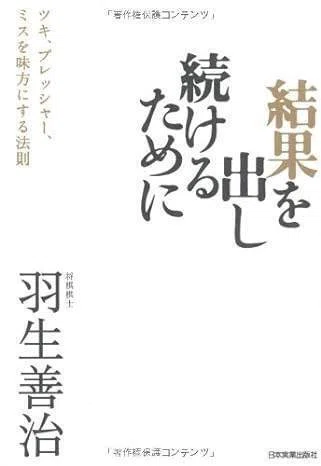
"Happiness is not something that stays in one place and says, 'I am happy now.' It is something that continues to change and discover new things as it continues to change. It is a process of continually finding and searching for what is rewarding and fulfilling."
Also, the boundary between happiness and unhappiness is as difficult to know as the boundary between right and wrong.
If I seem to be happy now, I try to think about what kind of events have greatly benefited me.
It is very difficult to live freely.
Fortune and happiness.
Fortune means to be lucky.
Happiness is a full heart.
As long as we are alive, we feel happiness or unhappiness every day by the power of chance and luck, and our feelings change from moment to moment.
Even if you are happy now, you never know what tomorrow will bring.
Again, the fact that you say "until death" here means that if it is after death, then you can say you are a happy person.
If that is the case, if there is a difference between luck and happiness, it is the difference between process and result.
We don't say "lucky" to a dead person.
Even if we did, we would say, "He was lucky," in the past tense.
In other words, the middle of the road is good luck, and the end point is happiness.
Even those who are in a fortunate situation now are not ready to draw conclusions yet.
After all, they are still in the middle of the road.
After that, there is a possibility that something unfortunate will happen.
Conversely, those who are in an unfortunate situation are also not ready to draw conclusions yet.
After all, they are still in the middle of the road.
After that, happy things may happen.
"Until death, we may call a man fortunate, but we must refrain from calling him happy." (Herodotus, History, vol. 1, p. 35)
[Reference Book 7]
"The Histories, Vol. 1" (Iwanami Bunko) by Herodotus, translated by Chiaki Matsudaira

"The Histories, Vol. 2" (Iwanami Bunko) by Herodotus, translated by Chiaki Matsudaira

"The Histories, Vol. 3" (Iwanami Bunko) by Herodotus, translated by Chiaki Matsudaira

Paragraph 4: Life is about finding stars and weaving constellations.
These words appear in the essay "Picking up the Stars" by Seisensui Ogiwara.
"Life is about finding jewels in the dust."
The author, a haiku poet, suddenly remembered these words while editing a collection of self-selected haiku.
He then compares the gems to the stars in the night sky and continues to edit them as if he were finding constellations and nebulae there.
"I am not daring to try to pick up a large number of them. I want to pick up the really big stars, the really beautiful stars, and exercise them as a star system in a single stratocumulus."
Finding what shines in one's life and weaving it into the past, present, and future.
I remember Steve Jobs once described it as "Connecting the Dots".
Whether or not we can find stars and constellations in our memories can make a big difference in our sense of happiness.
So maybe we can think of memory as having a mind of its own.
But our human being is made up of about 60 trillion cells, several hundred billion of which are replaced in a day.
How can we retain our memories when, at the cellular level, we become a different person in six months?
Biologist Shinichi Fukuoka pointed out that it may be the action of neural circuits.
In other words, the stars in the night sky are the cells, and the constellations are the neural circuits.
The idea is that even if the stars that make up a constellation are replaced, the shape of the constellation remains and memory resides within that shape.
Are we creatures that continue to search for stars and find constellations without being aware of it?
What is life?
If I were to answer, "Life is to find the stars and to create constellations," it would be a romantic yet essential answer, I feel.
[Reference Article]
[Reference Book 8]
"Issa Zuiso" (Kodansha Bungei Bunko) by Seisensui Ogiwara

Paragraph 5: Love is trust in chance.
"A Century of Love," a philosophy book by Alain Badiou, is a book I came across through the "Love and Chance" connection by Shuzo Kuki.
[Reference Literature]
[Reference Article]
It is indeed French to talk about the world with love even after 70 years of age.
We are used to thinking in such a way that we order and perceive the world in an identity-based organizational system with definitions.
But if we let it go too far, if it becomes too rigid, we lose surprise and inspiration, and our lives become boring.
Isn't it love that releases the shackles of the mind from such logical thinking?
"Love, taken as itself, is almost nothing. It begins with a single encounter. We learn that we can explore the world not merely by sameness but by difference."
"Love is truly a trust placed in chance, if not quite pre-calculated as a profitable investment, not conceived as an exchange of mutual interests. Love moves us into the realm of our fundamental experience of what difference is, and the idea that one can, after all, explore the world in terms of difference."
The development of the story is similar to that of Kuki, who taught about chance through love.
It is said that the exploration of the world begins with the surprise of coincidence, and that love is the first step in this exploration.
Japanese classics seem to be, roughly speaking, all about love, but what do you think?
Even in Tsurezuregusa, there are subtle hints of love, aren't there?
I think we should throw away the idea that there are no classics in Japan that teach proper philosophy and thought.
"Love is something that transcends all solitude and concerns everything in the world that seeks to give life and vitality to survival. I know it. The world is immediately the source of the happiness that being with others gives me. The words "I love you" could mean that the world is the source of my happiness, which is you."
What a beautiful conclusion to Badiou's story.
[Reference Book ⑨]
"In Praise of Love" by Alain Badiou and Nicolas Truong, translated by Takashi Ichikawa

[Related Articles]
[Random notes] Instantaneous English Composition Training (Diary Edition@2023/12/21)
https://note.com/bax36410/n/na300148fa075
[Random notes] Instantaneous English Composition Training (Business Skills edition@2023/12/22)
https://note.com/bax36410/n/n98d9866425fe
[Random notes] Instantaneous English Composition Training (Book report edition@2023/12/23)
https://note.com/bax36410/n/n7ba9fcf73cf7
[Random notes] Instantaneous English Composition Training (Book report and Translation edition@2023/12/24)
https://note.com/bax36410/n/n1129bcac9b0e
[Random notes] Instantaneous English Composition Training (Diary and Translation edition@2023/12/25)
https://note.com/bax36410/n/n366840f35f42
[Random notes] Instantaneous English Composition Training (Diary Edition@2023/12/26)
https://note.com/bax36410/n/nedd3dc8bf4e0
[Random notes] Instantaneous English Composition Training (Diary Edition@2023/12/27)
https://note.com/bax36410/n/n13142d2060b5
[Random notes] Instantaneous English Composition Training (Book report edition@2023/12/28)
https://note.com/bax36410/n/n25b766b7c7ac
[Random notes] Instantaneous English Composition Training (Diary Edition@2023/12/29)
https://note.com/bax36410/n/n5547f7c94895
[Random notes] Instantaneous English Composition Training (Diary and Translation edition@2023/12/30)
https://note.com/bax36410/n/nb1973f862804