
[One Hundred People, One Haiku] Taking a Close-up (Looking for the Fun) (Part 3)


"Shiki 365 Days" by Itsuki Natsui (Asahi Shinsho)

A book where you can read Shiki's haiku by date.
This book features 365 haiku, one for each day of the year, all with different seasonal words, as per the concept of enjoying the year by reading and savoring the poems Masaoka Shiki wrote on those specific days, selected by fellow haiku poet Itsuki Natsui with the sensibility of a practitioner.
The haiku selected by the poet, famous on television as a "harsh critic," teach us about various aspects of Shiki's life.
For example, September 1st.
“At the Great Buddha, there is no 210th day of the year”
The author, who evaluates this haiku from 1895 as
“a humorous haiku”
also casually touches upon Shiki's intuition in 1896, when he wrote
“Even an earthquake is mixed into the 210th day”
The author's lighthearted, and at times piercing, writing style feels refreshing.
It seems that the rhythm of short-form poetry has become part of her very being.
Masaoka Shiki left behind about 24,000 haiku in his short life of 34 years.
I am surprised once again at how many diverse haiku Shiki created.
To think that even in such a harsh life, he could be so cheerful, bright, and heartwarming.
Even among his lesser-known poems, there are heartwarming masterpieces and unique works that are quintessentially Shiki, making this a book that brings home the reality of Shiki's intense life and the wonder of haiku.
As if to object to the focus being solely on his tragic final years and death poems, it highlights his travel poems from his energetic days and free-form poems with overlapping seasonal words.
This book offers a new perspective on his work.
Shiki, who is airy, cheerful, biting, and kind
I believe the charm of this book lies in how it highlights the brightness of his spirit. (^^)
Regarding the nature of an artist who even objectifies their own battle with illness,
I was able to re-encounter Masaoka Shiki, a haiku poet who possessed rare curiosity and a fighting spirit like a ball of energy
I think this book, in which the author writes these words, will be a joy for readers.
Now, from the 365 haiku, I have selected some by season based on my own personal preferences. (^^)
First Dreams: January to March
●It's around here, there's a house, and the plum blossoms are blooming too1894 (Meiji 27)
It starts right off with dialect.
The phrase 'It's around here' sounds so slow-moving.
The 'plum blossoms' are beginning to smile.
It suits the mood of the weather. The hand-drawn map that was sent must have been rough and hard to understand, but the fact that the single character for 'plum' in the letter was the deciding factor makes this a lighthearted and fun episode, doesn't it? says the author.
●Spring rain, the temple hall is full of pigeons1893 (Meiji 26)
There is no pretense.
It's a haiku that makes you feel that Shiki was a straightforward person.
The author's commentary is interesting.
A haiku with the preface 'Asakusa Kannon'.
Actually, this is a haiku I sometimes borrow as teaching material for my 'Haiku Live' classes, which I conduct while visiting schools across the country.
I line up this haiku with two others and play a guessing game: 'Which one was written by an elementary school student?'
This haiku is overwhelmingly chosen by elementary school students as the one written by an elementary school student.
They say, "The fact that it's full of pigeons looks childish no matter how you see it."
No, no, you guys, this way of speaking is exactly what makes Shiki so charming.
"Cherry Blossom Viewing: April to June"
Shiki is also a genius at using onomatopoeia (mimetic and sound-symbolic words).
●"On the wooden floor, the sea bream flops and splashes"1894 (Meiji 27)
The situation where a "cherry sea bream" is "flopping and splashing" on the wooden floor.
It's not 'pichi-pichi' (lively splashing).
This linguistic sense is amazing.
A live fish is dancing.
●"Tsushima seen as a tiny speck in the haze"1895 (Meiji 28)
That year, Shiki, unable to contain himself while his close friend Akiyama and others headed to the front lines of the Sino-Japanese War, crossed over to the Liaodong Peninsula as a war correspondent.
On the way, this is a haiku he wrote while looking back at "Tsushima," which appeared as a "tiny speck" from the ship heading to Dalian.
Shiki, who serialized his "War Diary" in the newspaper, coughed up blood on the ship returning home.
After barely surviving in Kobe, he moved into the boarding house of Soseki, who was a middle school teacher in Matsuyama, and spent over 50 days there.
It is said that he returned to Tokyo while suffering from severe pain in his lower back due to caries, as the tuberculosis bacteria attacked his spinal cord.
"Summer Stars: July to September"
When he was healthy, Shiki traveled extensively on foot.
He was very active.
He was a bundle of curiosity.
There was even a time when he aspired to be a politician.
I would like to introduce one haiku that makes the scene before your eyes open up wide.
●A single boat passes through the rainbow and heads home 1890 (Meiji 23)
After a summer shower, a single rowboat heads home leisurely, as if passing through the rainbow that has appeared over the sea.
The contrast between the vast nature and the boat seems to convey Shiki's determination toward literature.
●Summer grasses, and the baseball players are far away 1898 (Meiji 31)
Shiki had a deep connection to baseball; he used his childhood name 'Noboru' as a pun on 'baseball' to create the pen name 'Yakyū' (written with characters for 'field' and 'ball').
It is said that his position was catcher.
“Bellflower: October–December”
●Cooking pork, on a night when the Ueno storm rages 1893 (Meiji 26)
The author explains why cooking pork is a winter seasonal word as follows:
“In Buddhist teachings, eating animal meat is considered evil, but eating nutritious deer or boar meat during the cold season was called 'kusurigui' (medicinal eating), and this became a winter seasonal word.
In the case of this haiku, it is safe to judge that 'cooking pork' corresponds to this seasonal word 'kusurigui.'”
●Soseki comes, Kyoshi comes, it is New Year's Eve 1895 (Meiji 28)
His disciples and friends spoke of Shiki's personality with sharp tongues.
“Soseki remarked, 'If one tried to assert oneself too much, he was not a man with whom one could have a smooth relationship,' and his disciple Kyoshi found him to be a thorn in his side.
However, isn't the charm of Shiki, including such harsh words, the emotion overflowing at the root of this haiku?”
On September 19, 1902 (Meiji 35), Shiki departed for the afterlife, watched over by his mother and sister.
He held his brush until 12 hours before his death, leaving behind three final haiku about loofahs.
For Shiki, who suffered from tuberculosis, loofah water, which was said to be effective for suppressing coughs and clearing phlegm, was his water of life.
●I did not even collect the loofah water the day before yesterday
●“A to of phlegm, even the loofah water is not in time”
●“The loofah blooms, a Buddha choked with phlegm”
The author writes, "The objectivity of calling oneself a 'Buddha' on the verge of death is supported by an indomitable spirit of humor, and it culminated in this death poem."
Finally, while there are many places associated with Shiki, including the 'Shikian' in Negishi, the one I would recommend is the 'Shikido' in Matsuyama.
It is a literary museum where the residence where Shiki spent his time until he was 17 has been reconstructed on the temple grounds.
It is strange how you feel as if a life-sized Shiki is actually there (^^)
[Reference Books]
"Shiki Haiku Collection" (Iwanami Bunko) by Masaoka Shiki, edited by Takahama Kyoshi

"Masaoka Shiki: If There Is Haiku, There Is Japanese Literature" (Minerva Japanese Biography Selection) by Inoue Yasushi

"Masaoka Shiki" (Shincho Bunko) by Donald Keene

"Retracing to Shiki" (Gendai Tanka Sha Selection) by Otsuji Takahiro

[Reference Materials]
[One Hundred People, One Haiku] Taking a Close-up (Trying to See the Interest) (Part 3)
“Quiet water sinks, a summer evening”
(From Yuko Masaki's "Quiet Water")

“Quiet power fills, a grasshopper leaps”
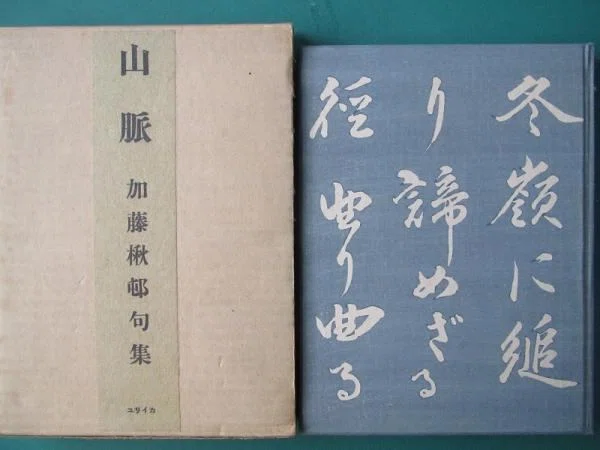
(From Kato Shuson's "Mountain Range")
“Draping a shirt over the weeds”
(From Kuribayashi Issekiro's "Kuribayashi Issekiro Haiku Collection")

“There are so many pampas grasses, there is one pampas grass, I'm tired, I'm tired”
(From Inaba Nao's "Several Moments")

“Soaked through, a puppy”
(From Jutaku Kenshin's "Jutaku Kenshin Complete Haiku Collection: The Whole Reality - The Night Was Lonely and Someone Started Laughing")

“Rustling and falling silent, at the bamboo leaves, a mortar place”
(From Ooka Shoji's "Mortar Place")

“Dandelion, dandelion, spring opens its eyes on the sandy beach”
(From Ogiwara Seisensui's "Ogiwara Seisensui")

“Let's beat the drum with chi-chi-po-po, a flowery moonlit night”
(From Matsumoto Takashi's "Hawk")

"Ladybug, what sin could you have committed to carry stars on your back?"
(From Reon Kudo's 'It's Better Not to Make Me Hungry')

"Kites, crows, and seagulls can be heard; the wind signals snow."
(From Umon Kanao's 'Complete Haiku Collection of Umon Kanao')
[Related Articles]
<Tanka>
[100 Tanka for 100 People (Modern/Contemporary Tanka)] A Certain World (Part 1)
https://note.com/bax36410/n/nf8e5e47f578a
[100 Tanka for 100 People (Modern/Contemporary Tanka)] A Certain World (Part 2)
https://note.com/bax36410/n/n353e5be2445e
[100 Tanka for 100 People (Modern/Contemporary Tanka)] A Certain World (Part 3)
https://note.com/bax36410/n/nbb5a13ca8405
[100 Tanka for 100 People (Modern/Contemporary Tanka)] A Certain World (Part 4)
https://note.com/bax36410/n/n0090664bcf33
[100 Tanka for 100 People (Modern/Contemporary Tanka)] A Certain World (Part 5)
https://note.com/bax36410/n/n9c0ff103b72c
[100 Tanka for 100 People (Modern/Contemporary Tanka)] A Certain World (Part 6)
https://note.com/bax36410/n/n066b0410eafa
[100 Tanka for 100 People (Modern/Contemporary Tanka)] A Certain World (Part 7)
https://note.com/bax36410/n/n43fdb643550c
[100 Tanka for 100 People (Modern/Contemporary Tanka)] A Certain World (Part 8)
https://note.com/bax36410/n/n6478294052d2
[100 Tanka for 100 People (Modern/Contemporary Tanka)] A Certain World (Part 9)
https://note.com/bax36410/n/n794a601eb10a
[100 Tanka for 100 People (Modern/Contemporary Tanka)] A Certain World (Part 10)
https://note.com/bax36410/n/nef42320214fa
<Haiku>
[100 Haiku for 100 People] Taking a Close-up (Trying to See the Interest) (Part 1)
https://note.com/bax36410/n/n5c97e0bdf258
[100 Haiku for 100 People] Taking a Close-up (Trying to See the Interest) (Part 2)
https://note.com/bax36410/n/n0a3e48a832f3
[100 Haiku for 100 People] Taking a Close-up (Trying to See the Interest) (Part 4)
https://note.com/bax36410/n/n9392f27683df
[100 Haiku for 100 People] Taking a Close-up (Trying to See the Interest) (Part 5)
https://note.com/bax36410/n/n57dcb79b2c3b
[100 Haiku for 100 People] Taking a Close-up (Trying to See the Interest) (Part 6)
https://note.com/bax36410/n/n94bfae427e3e
[100 Haiku for 100 People] Taking a Close-up (Trying to See the Interest) (Part 7)
https://note.com/bax36410/n/n03ae4a228fb0
[100 Haiku for 100 People] Taking a Close-up (Trying to See the Interest) (Part 8)
https://note.com/bax36410/n/nacaa5528c5a8
[100 Haiku for 100 People] Taking a Close-up (Trying to See the Interest) (Part 9)
https://note.com/bax36410/n/nb8c8bb795a19
[100 People, 100 Haiku] Taking a Closer Look (Trying to Find the Interest) (Part 10)
https://note.com/bax36410/n/nf5d7a178aa52