
★[Defense] Defensive Movements and Covering (Runners on 1st and 2nd, Ball hit to the outfield)

(In this note, I simulate the process of 'building a strong high school baseball team' from various angles using a hypothetical high school. I hope this will be of some help to everyone involved in baseball.)
Thinking about the team development process to reach Koshien and become Japan's number one: 'Kudo Note High School Baseball Club' | Yasuhiro Kudo

This covers the responses and covering movements when a ball is hit to the 'standard position' of each defensive player.
<<Basic Concept>>
● The numbers and basic defensive positions for each position are shown in the figure below.
1 Pitcher (P) 2 Catcher (C)
3 First Baseman (1B) 4 Second Baseman (2B)
5 Third Baseman (3B) 6 Shortstop (SS)
7 Left Fielder (LF) 8 Center Fielder (CF)
9 Right Fielder (RF)

● Every fielder must move in response to the batted ball.
There is no position that does nothing.
(Covering the batted ball, covering throws, covering bases)
● Do not perform covering for balls that are clearly foul. However,
always perform covering for balls that are on the edge of being fair or foul.

The latest high school baseball magazines are summarized in this link
(Updated once a month) 👇


We clarify the basic diagrams so that all players understand how to move for covering in each case, and we repeatedly simulate this in practice (to the point where they can move unconsciously during games).
If even one of the nine players moves differently here, it will lead to an open position (base) or a lack of coordination, so 'ensuring everyone understands and can move according to the basic diagram' is a major point for the team.
However, it is okay to make different movements in a game depending on the situation (based on split-second judgment).
* With 2 outs, you only need to get the batter-runner out, so the movement is basically the same as when there are no runners.
This assumes the situation with 0 or 1 out.
The pre-positioning when there are runners on 1st and 2nd is...
↓ Click here for items related to defense!
★[Defense: Start Here] Dominate the game with your team's defensive strength | Yasuhiro Kudo
* By case
★[Defense] Covering: No runners, ball hit to the infield | Yasuhiro Kudo
★[Defense] Covering: No runners, ball hit to the outfield | Yasuhiro Kudo
★[Defense] Covering: Runner on 1st, ball hit to the infield | Yasuhiro Kudo
★[Defense] Covering: Runner on 1st, ball hit to the outfield | Yasuhiro Kudo
★[Defense] Covering: Runner on 2nd, ball hit to the infield | Yasuhiro Kudo
★[Defense] Covering: Runner on 2nd, ball hit to the outfield | Yasuhiro Kudo
★[Defense] Covering: Runner on 3rd, ball hit to the infield | Yasuhiro Kudo
★[Defense] Covering: Runner on 3rd, ball hit to the outfield | Yasuhiro Kudo
★[Defense] Covering: Runners on 1st and 2nd, ball hit to the infield | Yasuhiro Kudo
★[Defense] Covering: Runners on 1st and 2nd, ball hit to the outfield | Yasuhiro Kudo
★[Defense] Covering: Runners on 1st and 3rd, ball hit to the infield | Yasuhiro Kudo
★[Defense] Covering: Runners on 1st and 3rd, ball hit to the outfield | Yasuhiro Kudo
★[Defense] Covering: Runners on 2nd and 3rd | Yasuhiro Kudo
★[Defense] Covering: Runners on 1st, 2nd, and 3rd, ball hit to the infield | Yasuhiro Kudo
★[Defense] Covering: Runners on 1st, 2nd, and 3rd, ball hit to the outfield | Yasuhiro Kudo

* Outfield fly balls
In the case of an outfield fly ball, you only need to care about the runner on 2nd (because the runner on 1st cannot advance unless the runner on 2nd advances), so the response method is the same as the case with a runner on 2nd.
case.
🥎 Single to left (7 to 5, 7 to 5 to 2)

◉ Movements for each position
<<Priority>>
(1) Covering for catching the hit (ground ball)
(2) Covering for the throw to home
(3) Covering for the throw to 2nd
● Catching a base hit (ground ball) ... 7
Catch the ball while moving forward (do not prioritize safety by dropping your hips to catch it), and use that momentum to throw to home plate.
Aim to throw to home plate with a one-hop trajectory, and be careful not to let the ball float.
(If the ball floats, it may result in a run scoring and the batter-runner/1st-base runner advancing an extra base.)
If it is clearly too late to make a play at home, switch to throwing to 3rd base.
● Going to field the ball ... 5, 6
It is best if you can turn it into an infield grounder, but even just stopping the ball is effective. (Reduces throwing/catching actions and the possibility of errors.)
After handling the ball, 6 covers 3rd base. After handling the ball, 5 moves to act as a relay for 7's throw (on the line toward home plate).
● Covering for errors when fielding a left-field hit ... 8
Respond to a ball getting past 7 by moving at full speed (only 8 is available to cover). After confirming the catch, move to cover the throw to 2nd base.
● Acting as a relay for the throw to home ... 5
Go to field the ball, and while maintaining that flow, position yourself on the line connecting 7 and home plate. If the throw to home is not in time, check the movement of the 1st-base runner who advanced to 2nd.
● Covering home plate ... 2
Do not leave home plate and give instructions for the relay play. (Adjust the 3rd baseman's cut position, give instructions to cut or let it go.)
If the batter-runner or 1st-base runner attempts to advance further or overruns after the catch, make a throw.● Covering for a wild throw to home ... 1
Move to cover according to the angle of the throw.
● Covering 3rd base ... 6
Go to field the ball, and while maintaining that flow, cover 3rd base.
● Covering 2nd base ... 4
If the batter-runner is attempting to advance, call for the ball to make a throw.
● Covering for a wild throw to 2nd ... 9
Move to cover the throw to 2nd base; ensure you get there, as a missed ball could lead to a major run-scoring play.
● Covering 1st base ... 3
Cover 1st base when the batter-runner returns to 1st.
Stand in a position that does not obstruct the batter-runner's path (basically inside the base line) and confirm if they touched 1st base.
Do not leave the base after they pass, so you can respond to an overrun. If the runner's overrun is significant, call for the ball to make a throw.
🥎 Center-field hit (8→3, 8→3→2)

◉ Movement of each position
≪Priority≫
① Covering for catching a base hit (ground ball)
② Covering for a throw to home plate
③ Covering for a throw to 3rd base
● Catching a base hit (ground ball) ... 8
Catch the ball while moving forward (do not prioritize safety by dropping your hips to catch it), and use that momentum to throw to home plate.
Aim to throw to home plate with a one-hop trajectory, and be careful not to let the ball float.
(If the ball floats, it may result in a run scoring and the batter-runner/1st-base runner advancing an extra base.)
After the throw, move to cover in preparation for the batter-runner advancing to 2nd base.
● Going to field the ball ... 4, 6
It is best if you can turn it into an infield grounder, but even just stopping the ball is effective. (Reduces throwing/catching actions and the possibility of errors.)
After handling the ball, 6 covers 2nd base. After handling the ball, 4 moves to cover 1st base.
(As much as possible, since 3 will be involved in the relay play.)
However, if it is difficult for 8 to return the ball to the relay, move to act as the relay (between 8 and 3).
● Covering for errors when fielding a center-field hit ... 9
Respond to a ball getting past by moving at full speed.● Acting as a relay for the throw to home ... 3
Position yourself on the line connecting 8 and home plate. Position yourself roughly between 2nd base and the mound.
If the throw to home is not in time, check the movement of the 1st-base runner who advanced to 2nd.
● Covering home plate ... 2
Do not leave home plate and give instructions for the relay play.
(Adjust the 1st baseman's cut position, give instructions to cut or let it go.) If the batter-runner or 1st-base runner attempts to advance further or overruns after the catch, make a throw.
● Covering for a wild throw to home ... 1
Move to cover according to the angle of the throw.
● Covering 3rd base ... 5
● Covering for a wild throw to 3rd ... 7
● Covering 2nd base ... 6
Cover 2nd base when the batter-runner advances to 2nd. If the batter-runner or 1st-base runner attempts to advance further or overruns after the catch, call for a throw.
● Covering 1st base ... 4
Since you went to field the ball, get as close to the cover position as possible.
🥎 Right-field hit (9→3, 9→3→2)

◉ Movement of each position
≪Priority≫
① Covering for catching a base hit (ground ball)
② Covering for a throw to home plate
③ Covering for a throw to 3rd base
● Catching a hit (ground ball) ... 9
Catch the ball while moving forward (do not drop your hips to catch it for safety first), and use that momentum to throw to home plate.
Throw to home plate with the image of a one-hop throw, and be careful not to let the ball float.
(If the ball floats, there is a possibility of the runner scoring at home + the batter-runner and 1st base runner advancing one extra base)
● Going to field the ball ... 3, 4
It is best if you can turn it into an infield ground out, but even just stopping the ball is effective (reduces throwing/catching actions, reduces the possibility of errors)
After handling the ball, 4 covers 1st base After handling the ball, 3 acts as a relay for 9's throw (on the line of the throw toward home plate)
● Covering for errors when catching a right-field hit ... 8
Respond to 9 missing the ball, move in at full speed (only 8 is available to cover) After confirming the catch, move to cover the throw to 2nd base
● Acting as a relay for the throw to home plate ... 3
Go to field the ball, and while maintaining that flow, move onto the line connecting 9 and home plate
If the throw to home plate will not be in time, check the movement of the 1st base runner who advanced to 2nd
● Covering home plate ... 2
Do not leave home plate, and give instructions for the relay play
(correcting the 1st baseman's cut position, giving instructions to cut or let it go) After catching, if the batter-runner or 1st base runner aims to advance further or overruns, etc., make a throw
● Covering for a wild throw when throwing to home plate ... 1
Start moving to cover 1st base, but if the ball goes through the gap between 1st and 2nd, move to cover the throw to home plate
● Covering 3rd base ... 5
● Covering for a wild throw when throwing to 3rd base ... 7
● Covering 2nd base ... 6
Cover 2nd base when the batter-runner advances to 2nd
After catching, if the batter-runner or 1st base runner aims to advance further or overruns, etc., call for a throw
● Covering for a wild throw when throwing to 2nd base ... 8
● Covering 1st base ... 4
Cover 1st base when the batter-runner returns to 1st
If the runner's overrun is large, call for the ball to make a throw
※ Long hits down the left or right foul line
In the case of a ball hit along the line for a long hit, it is impossible to prevent the 2nd base runner from scoring at home, so the response is only for the 1st base runner and the batter-runner.
The response method is the same as in the case of a runner on 1st base.
🥎 Left-center double/triple (7 or 8 → 6, 7 or 8 → 6 → 5)
※ Preventing the 1st base runner from scoring at home is the most important point, but because quick judgment and formation are required, it is important for everyone, including other fielders and bench players, to communicate with each other based on the catcher's instructions.

◉ Movement of each position
≪Priority≫
① Covering for catching a hit
② Covering for a throw to 3rd base
③ Covering for a throw to 2nd base
● Catching a hit ... 7 or 8
If you cannot make it to the ball in time, you will be catching a cushion ball, so
be careful of how the ball bounces off the cushion
If you are not handling the hit, move to cover for fumbles, etc.
After catching, make a quick, fast throw to the relay
Since you are handling the ball while facing backward, throw to the target as instructed
● Relay for a throw to 3rd base ... 6, 4
Get on the straight line between the 7 or 8 who caught the ball and 3rd base and wait for the throw
(even in the case of a throwing error,
if you are on the straight line, the ball will go toward 3rd base)
Basically, 6 throws to home plate alone after catching the throw
4 acts as a cover for 6 because the distance to the home plate relay is long
However, do not get too close (keep a distance of about 10m from 6)
● Covering 3rd base ... 5
Give instructions for the relay play (correcting the relay position, cut or no-cut)
Be prepared to handle a loose ball if the relay is messy, but do not
position yourself too far from 3rd base (the batter-runner might aim to advance to 3rd)
● Covering for a wild throw when throwing to 3rd base ... 1
Start moving so you can go to either the 3rd base throw or the home plate throw
Be careful not to collide with the runner (not to obstruct the running path)
Also, be careful not to be too close to the 3rd baseman (so you can respond to a wild throw)
● Covering 1st base → Covering 2nd base ... 3
Cover 1st base until the batter-runner passes 1st base
(check if they stepped on the base?) After passing, cover 2nd base
Move toward 2nd base with the image of following behind the batter-runner
● Covering for a wild throw when throwing to 2nd base ... 9
If a rundown occurs between 2nd and 3rd base, join the rundown
● Covering home plate ... 2
Do not leave home plate, and give overall instructions
Check if the runner stepped on home plate
🥎 Right-center double/triple (8 or 9 → 4, 8 or 9 → 4 → 5)
※ Preventing the 1st base runner from scoring at home is the most important point, but because quick judgment and formation are required, it is important for everyone, including other fielders and bench players, to communicate with each other based on the catcher's instructions.
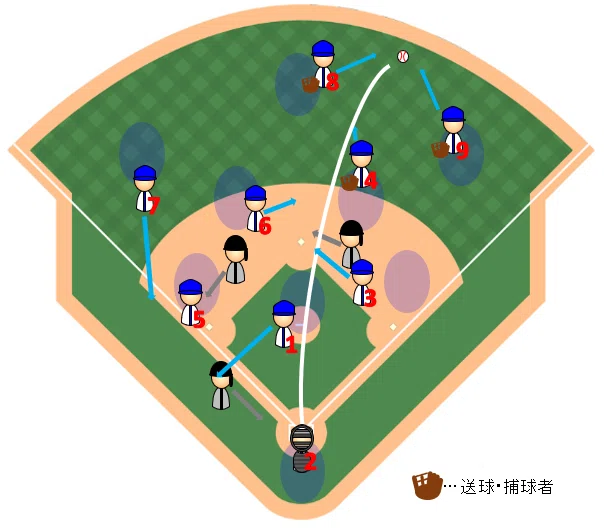
◉ Movement of each position
≪Priority≫
① Covering for catching a hit
② Covering for a throw to 3rd base
③ Covering for a throw to 2nd base
● Catching the hit ... 8 or 9
If you cannot reach the ball in time, you will be fielding a cushion ball, so pay attention to how it bounces off the wall.
If you are not fielding the ball, move to cover for potential fumbles.
(It is easier for 9 to field the ball smoothly.)
After catching, make a quick, strong throw to the relay man.
Since you are fielding the ball while facing backward, throw to the designated target.
● Relay to 3rd base ... 4 and 6
Position yourself on the straight line between the fielder (8 or 9) who caught the ball and 3rd base, and wait for the throw. (Even in the event of a throwing error, if you are on the straight line, the ball will go toward 3rd base.)
Basically, 4 should catch the relay throw and throw to home plate alone.
Since the distance for 6 to relay to home is long, 6 should be in a position to cover.
However, do not get too close.
● Covering 3rd base ... 5
Give instructions for the relay play (adjusting relay position, cut or no-cut).
Be prepared to handle a loose ball if the relay is messy, but do not stray too far from 3rd base (the batter-runner may try to advance to 3rd).
● Covering for a wild throw to 3rd base ... 7
7 should move to cover based on the angle of the throw; since it is far, move at full speed.
1 should start moving to be ready for either a throw to 3rd or home. Be careful not to collide with the runner (do not obstruct the base path).
Also, be careful not to get too close to the 3rd baseman (so you can handle a wild throw).
● Covering 1st base -> Covering 2nd base ... 3
Cover 1st base until the batter-runner passes it.
(Check if they touched the base.) After they pass, cover 2nd base. Move toward 2nd base with the image of following behind the batter-runner.
● Covering home plate ... 2
Do not leave home plate and provide instructions to the whole team.
Check if the runner touched home plate.
* In this note, I earn income through qualifying sales as an Amazon Associate.
↓ Article updates will also be announced on X and our Facebook page.
「工藤note高校 野球部」甲子園・日本一までのチーム育成プロセス を考える|工藤 @kud1021 #note #高校野球 https://t.co/pOiXB1K2lV
— 工藤 (@kud1021) August 30, 2023
↓ These are recommended books to understand high school baseball and Koshien.
↓ I am registered with the Popular Blog Ranking (High School Baseball).
Please click the link.

いいなと思ったら応援しよう!
 よろしくお願いします!いただいたチップは、画像購入・AI利用等より充実したnoteを作るために使わせていただきます。