
Hayakitsu Educational Corp. Campus Building (Fictional)

1. Introduction
Hayakitsu Educational Corp. and Nissanzan Nishidake University have walked hand-in-hand with the development of Saibi City. As a symbolic presence for providing cutting-edge education and research, we have established the "Hayakitsu Educational Corp. Campus Building." Our campus provides an ideal environment for students and faculty to learn and grow.
2. Building Design and Structure
Exterior and Facade Design
The Hayakitsu Educational Corp. Campus Building is a magnificent structure reaching a height of 470 meters, standing tall as a symbol of the city. The all-glass facade maximizes natural light, providing a sense of openness and transparency. This design helps capture the beautiful urban landscape while maintaining a comfortable interior environment. The design, inspired by a sailing ship, reflects the culture and history of Saibi City as a maritime city, with the mast-shaped tower at the top forming a distinctive silhouette.
Modular Structure
The building adopts a modular structure, which is an architectural technique that enables flexible space utilization and efficient construction. Due to the modular structure, the interior space can be easily reconfigured according to its purpose, with areas featuring diverse functions such as classrooms, labs, and conference rooms. This design also allows for smooth future expansion or renovation of the facilities, making it possible to accommodate the overall development of the campus.

Sustainable Building Materials
Sustainable building materials are used in the Hayakitsu Educational Corp. Campus Building, ensuring consideration for the environment. High-performance insulation improves energy efficiency while enhancing the comfort of living spaces. Furthermore, the exterior walls are treated with a special self-cleaning coating, which reduces maintenance frequency while playing a role in maintaining aesthetics.

Environmentally Harmonious Design
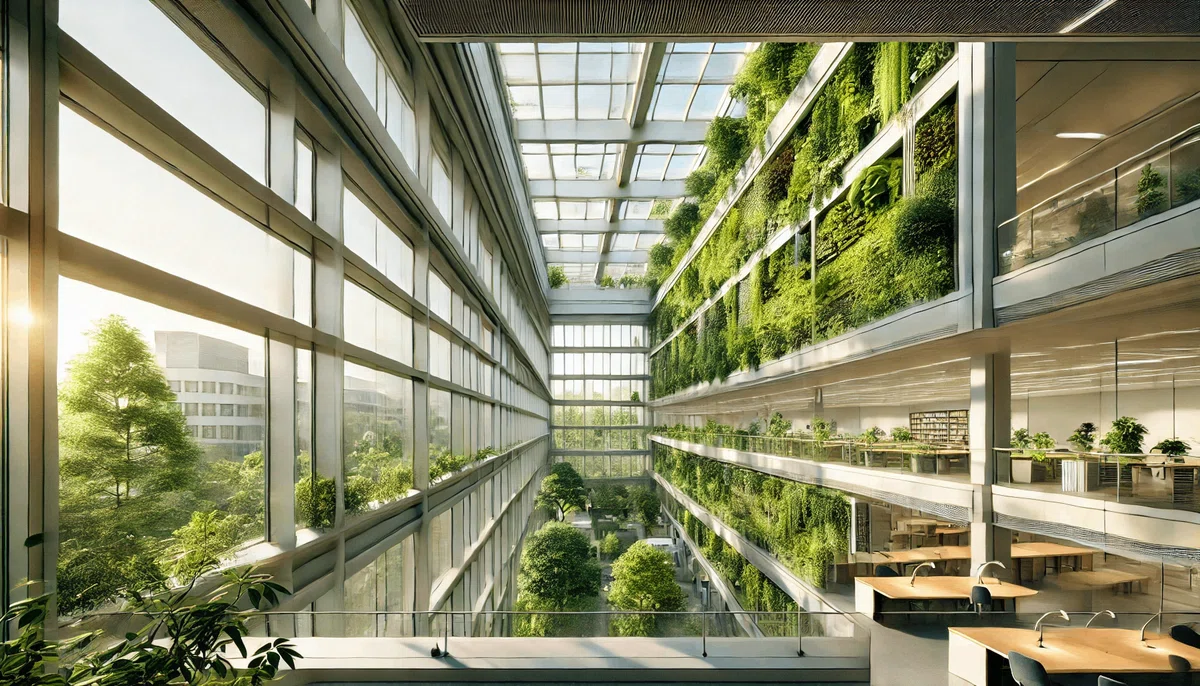
The building's design is conscious of harmony with the environment. Green walls and rooftop gardens contribute to urban greening and also help regulate the building's temperature. Additionally, these green spaces enrich the landscape both inside and outside the campus, providing a place for students and faculty to interact with nature. In this way, the building functions not just as an educational facility, but as part of the city's ecosystem.
3. Functionality and Facilities
Latest Educational Technology and Equipment
The Hayakitsu Educational Corp. Campus Building incorporates state-of-the-art educational technology, providing an optimal learning environment for students and faculty. Smart classrooms are equipped with the latest devices such as digital boards, projectors, and tablets, promoting interactive communication and collaboration during classes. Furthermore, interactive labs incorporate VR/AR technology that enables virtual experiments and simulations, allowing students to acquire practical skills through experiences close to the actual field.

Support for Creative Activities
Within the campus, there are numerous collaboration spaces that students and faculty can use freely. These spaces feature flexible layouts that can accommodate various academic activities such as group discussions, project work, and research meetings. Additionally, each space is equipped with whiteboards and digital displays, making visual idea sharing and presentations easy. This supports the development and realization of creative ideas.

Comfortable learning environment
The design maximizes natural light, creating a bright and open space within the building. Large windows on each floor allow students and faculty to enjoy natural daylight while studying or working. Additionally, the entire building is equipped with a state-of-the-art HVAC system, maintaining comfortable temperature and humidity levels throughout the year. There are also soundproofed areas, providing an optimal environment for research and study that requires deep concentration.

Multifunctionality and flexibility
The building's design is multifunctional, allowing for rapid layout changes based on specific needs. Classrooms and labs can be easily reconfigured to accommodate large lectures or small group seminars. Furthermore, the interior spaces are designed to support interdisciplinary projects that transcend academic boundaries. This enables students and faculty to adjust the environment to suit diverse learning styles, ensuring an optimal space for learning tailored to individual needs.

4. Eco-friendly features
Energy-efficient structure
The Hayakitsu Educational Corp. Campus Building is designed to maximize energy efficiency. The building features the latest solar power panels, providing a portion of its required electricity through clean energy. Wind turbines have also been installed to promote the use of renewable energy through wind power generation. This reduces reliance on fossil fuels and contributes to a lower carbon footprint. Additionally, high-performance insulation and advanced window glass technology are used to minimize the impact of outside air and maintain a constant indoor temperature.
Environmentally conscious design
The entire building incorporates environmentally conscious design elements. The facade features a green wall, which not only contributes to urban greening but also enhances the building's cooling effect. This provides a comfortable environment for occupants while reducing energy consumption. There is also a rooftop garden that helps with rainwater reuse and mitigates the urban heat island effect. These initiatives are part of sustainable urban development, fulfilling responsibilities to the local community and the environment.
Water conservation and recycling systems
Water resource conservation is also considered a key priority, with advanced water-saving equipment installed throughout the building. Low-flow faucets, toilets, and efficient irrigation systems are standard, minimizing water waste. The building's design also incorporates a rainwater harvesting system, where collected rainwater is reused for irrigation and toilet flushing. Furthermore, recycling facilities are in place to ensure thorough waste sorting and recycling.
Use of sustainable materials
Environmentally friendly materials have been selected for the building's construction. For example, renewable wood and recycled materials are used to reduce resource waste. Low-VOC (volatile organic compound) paints and adhesives are also used to improve indoor air quality and provide a healthy environment. These material choices make it possible to maintain high durability and aesthetic appeal while minimizing environmental impact.
5. Location and environmental conditions
The charm of Sayaibi City
The Hayakitsu Educational Corp. Campus Building is located in Sayaibi City, where natural beauty and urban convenience merge. This port city is surrounded by the beautiful scenery of a ria coastline and a rich natural environment, offering a relaxed living environment. The city is developing as a smart city, with advanced infrastructure and digital technology integration. The culture and history of Sayaibi City offer unique appeal to both local residents and visitors, deepening connections with the local community.
Natural environment and landscape
The campus is surrounded by lush mountain ranges and a beautiful waterfront, providing an environment where students and faculty can enjoy interacting with nature. The mountains offer scenery that changes with the seasons, and the views from the campus are breathtaking. Additionally, there are vast parks and green spaces nearby, which are used for outdoor activities and relaxation. These natural surroundings also provide inspiration for academic exploration and creative activities.
Urban Planning and Infrastructure
Saiki City is committed to sustainable urban development and environmental protection. The entire city is designed as a smart city, equipped with efficient public transportation systems and eco-friendly infrastructure. The Hayakitsu Educational Corp. Campus Building is located near highways and high-speed railway stations, offering excellent transportation access. There is also an international cruise ship port nearby, making it easy to access from both domestic and international locations. This allows students and faculty to enjoy a comfortable and convenient living environment.
Relationship with the Community
The campus has strong ties to the local community and actively participates in regional events and community programs. This promotes interaction between students and local residents, contributing to the development of the entire region. Furthermore, there are art pieces and exhibitions reflecting local culture both inside and outside the campus, which serve as venues for cultural exchange. These activities contribute not only to education but also to the revitalization of the local community.
Due to these location and environmental conditions, the Hayakitsu Educational Corp. Campus Building provides an ideal place for learning where nature, the city, and the community are in harmony.
6. Voices of Students and Faculty
The Appeal of the Learning Environment In student interviews, smart classrooms and interactive labs are praised for making learning more enjoyable and effective. Faculty members also highly value the state-of-the-art facilities for helping to improve the quality of their classes.
Student A (3rd-year, Department of Drone Science)
"In the smart classrooms at the Hayakitsu Educational Corp. Campus Building, I can experience drone simulations in real-time, which makes learning very easy. In classes using tablets and digital boards, I can visually learn how to analyze flight patterns and operate the drones, which deepens my understanding. In the interactive labs, I can use the latest VR technology to design and test drones, allowing me to acquire not just theoretical knowledge but also practical skills. Having these facilities in place further increases my motivation to learn."
Student B (2nd-year, Department of Energy Science)
"I especially like the experiments in the interactive labs. For example, by using virtual reality to simulate energy systems, I can gain a deep understanding of actual power generation processes and methods for improving efficiency. Also, in the smart classrooms, lecture content is displayed on digital boards, and I can take notes in real-time, making it easy to follow the class. Thanks to these latest facilities, learning has become more interactive and interesting."
Professor C (Department of Local Government Science)
"The smart classrooms at the Hayakitsu Educational Corp. Campus Building significantly improve two-way communication with students. By utilizing digital tools, I can visually explain complex concepts such as policy analysis and regional economic simulations, which helps deepen the students' understanding. Also, in the interactive labs, students can use actual data to analyze regional issues, providing a place for learning that connects theory with practice."
Lecturer D (Department of Energy Science)
"The introduction of the latest educational technology has significantly improved the quality of classes. In particular, the smart classrooms are very beneficial for students because they can demonstrate energy efficiency simulations and the effects of renewable energy in real-time. The interactive labs are also very important as a place for students to learn actual technology, providing valuable experiences for thinking about the future of energy. Having these facilities enriches the students' learning experience and draws out deeper understanding and interest."
7. Future Outlook
Sustainable Campus Initiatives
The Hayakitsu Educational Corp. Campus Building is taking proactive steps toward a sustainable society. There are plans to further expand the use of renewable energy and increase energy self-sufficiency in the future. In particular, the expansion of solar power generation systems and the addition of wind turbines are being considered, which is expected to significantly reduce the carbon footprint of the entire campus. Furthermore, regarding water resource management, we aim to achieve sustainable water use through the reuse of rainwater and the introduction of advanced water purification systems.
Future Projects and Expansion Plans
Many exciting projects are planned for the future of the campus. Among them, the construction of new facilities to support next-generation learning and research is particularly noteworthy. These new facilities will house dedicated labs to further strengthen research in next-generation AI (artificial intelligence) and data science. These labs will conduct cutting-edge research on real-time data analysis, autonomous decision-making, and the development of Artificial General Intelligence (AGI). This will enable students and researchers to acquire advanced skills for discovering new knowledge using big data and solving complex problems.
In addition, this facility will include studio spaces for creative arts and design. Here, the exploration of new forms of expression utilizing AI and digital tools will be advanced, and innovative projects through the fusion of technology and art are expected. This will allow students to explore new creative possibilities that go beyond traditional boundaries.
Furthermore, new collaboration spaces and community centers are planned to promote interaction among students, faculty, and staff. These spaces will incorporate the concept of human-machine collaboration, providing an environment where humans and AI work and learn together. Surrounded by advanced technology, this environment will foster interdisciplinary projects and innovation, serving as a place where students and faculty can integrate knowledge from various specialized fields to tackle problem-solving.
These facilities will also function as a venue for research on ethical guidelines and AI governance, promoting responsible use that considers the social impact of AI technology. This is expected not only to contribute to the development of future education and research but also to the development and dissemination of technology that is beneficial to society as a whole.
These initiatives position the campus as a global hub for research and education, providing a foundation for students and faculty to pioneer the future by leveraging cutting-edge knowledge and technology.
Digital Technology and Smart Campus
Due to the rapid advancement of digital technology, the Hayakitsu Educational Corp. Campus is evolving into an advanced smart campus. Learning support systems utilizing AI technology analyze each student's learning progress and style to provide individually optimized learning plans. This allows students to learn at their own pace and deepen their understanding. Additionally, in virtual classes using VR/AR technology, an environment is in place where students can acquire practical skills through experiences close to real-world settings.
Across the entire campus, the optimization of educational content using big data analysis is underway, with curriculum adjustments being made by analyzing student learning patterns. This improves the quality of education and maximizes learning outcomes. Furthermore, the combination of smart devices and IoT technology has realized the optimization of energy usage and the efficiency of facility management. These technologies play a role in enhancing the sustainability and safety of the campus.
In the future, it is expected that these digital technologies will evolve further, and the learning experience of each student will be even more personalized. It will become possible to provide resources and customize learning environments according to individual learning needs, realizing more individualized education. By incorporating these technological innovations, the Hayakitsu Educational Corp. Campus will continue to be at the forefront of future education and learning.
Collaboration with the Local Community
Collaboration with the local community is evolving in a way that integrates initiatives supporting digital technology and a sustainable society. The Hayakitsu Educational Corp. Campus Building is strengthening cooperation with the local community and further deepening partnerships to build a sustainable future together. With the advancement of digital technology, two-way communication with local residents and companies has been enhanced, and continuous dialogue and joint projects through online platforms are being promoted.
Collaboration with the local community includes the expansion of internship programs with companies, increasing opportunities for students to gain real-world experience while contributing to the local economy. In addition, public lectures and workshops for local residents are held regularly, and since these include remote participation, educational resources are provided to a wider range of participants. Furthermore, the campus functions as a hub for local environmental protection activities, with joint projects themed around the spread of renewable energy and the protection of ecosystems being developed.
The stance of respecting local culture and traditions is also being strengthened, and by incorporating these elements into educational programs and campus activities, learning opportunities are increasing for both students and local residents. In this way, the Hayakitsu Educational Corp. Campus Building is building deep connections with the local community and playing a central role in creating a sustainable future together.
8. Inquiries and Campus Visit Information
If you would like to visit the campus, please apply via the visit information page on our website. Also, please feel free to contact us by phone or email for any inquiries.
いいなと思ったら応援しよう!
 「クリエイティブの世界へようこそ!」
創造・表現することが好きで、日々新しいものを生み出しています。応援が次の創作の力になります!
「クリエイティブの世界へようこそ!」
創造・表現することが好きで、日々新しいものを生み出しています。応援が次の創作の力になります!