
Why do Kawasaki motorcycles have a "poison" and "romance" that Honda lacks? — The boundary between rationality and passion —

Introduction: A question surrounding the "endangered species" of the 4-cylinder 400cc engine
A few years ago, Kawasaki introduced the Ninja ZX-4R, bringing the roar of the "4-cylinder" back to the 400cc class. For our generation, who knew the old ZRX400, the Zephyr, or even further back, the FX, this was news that made us go wild with joy. However, at the same time, we are confronted with a cold reality. Faced with the high wall of modern exhaust gas regulations, multi-cylinder engines are burdened with the fate of "thin low-speed torque" and "increased costs." Therefore, the world is trending toward the idea that for small-displacement motorcycles, "parallel-twins are the optimal solution." Efficiency, fuel economy, and ease of handling. If you pursue these, the answer naturally converges on two cylinders, which seems to be the "correct answer" of the 21st century.
And, up to this point, this is just something I've heard from others. But between a 4-cylinder and a 2-cylinder, if you're a layman doing simple math, wouldn't the one with half the parts be more advantageous? It's not like it's a car... is what I can imagine. But is the "correct answer" really all we are looking for in a motorcycle?
1. Honda, which is an "extension of the Super Cub," and Kawasaki, which has the DNA of a "fighter jet"
I believe that motorcycle manufacturers have an irresistible DNA that comes from their origins.
Honda, the world's largest manufacturer. No matter how large the displacement becomes, their lineup is filled with a certain cleanliness and sense of security that feels like it is somewhere on the extension of the "Super Cub." Its ancestor is a mama-chari (city bike).You can seriously understand this when you ride a Honda. The philosophy of "making people happy through technology" advocated by Soichiro Honda created a level of perfection as the ultimate tool. If I were to go on a long-distance trip across Japan next, I find myself wishing to go on a Honda rather than a Harley. The sense of security is just different.
※As an aside... for a Harley crossing a continent, "breaking down" in the middle of the American desert could mean death. Therefore, reliability is important, which is why they use a V-twin so it can run even if one cylinder dies, and they adopt OHV so the structure is simple and easy to maintain at any gas station or garage around...
There are some of you who may have heard a story like that.
To be honest, that's a lie. It's an advertising article written by a writer who doesn't really understand, fueled by delusions and romance. If reliability were so important, my Harley wouldn't leak oil or seize up due to poor lubrication.

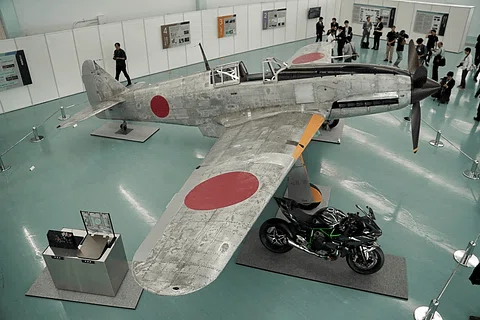
How about Kawasaki, in contrast? Kawasaki Heavy Industries is a part of a massive "heavy industry" conglomerate that handles aerospace, shipbuilding, and railway vehicles. For them, motorcycles are machines that fly in the sky—in other words, they are in the lineage of "fighter jets." While Honda is preoccupied with "eliminating unpleasant noise," Kawasaki stakes its life on "letting you hear the roar of the engine." Their rugged, and at times almost clumsy, strength makes me feel like they are doing branding that makes you think they "exist on the extension of a fighter jet"rather than being a "tool" that supports daily life. It is no coincidence that Tom Cruise, a fighter pilot, rode a GPZ900R in the movie Top Gun.
2. The decisive difference in philosophy told by "LCD meters" and "analog dual gauges"
This difference is most prominently displayed in the "meters" of recent new models.
Honda adopted a multi-functional LCD meter with excellent visibility for the latest CB1000F. It is a logical and correct evolution, and the number of parts is significantly reduced.

"Cutting-edge is justice. Consolidating information is sincerity toward the rider."
You can almost hear the voices of Honda's excellent engineers. However... since the body is designed in what is known as the "naked" style that Japanese people imagine, I can't help but feel a sense of discomfort here... or maybe not.

On the other hand, look at Kawasaki's Z900RS. They unexpectedly equipped it with analog dual gauges. The moment you turn the ignition, the two needles sweep, and they physically jump up in sync with the acceleration.

They dared to choose "needles," which cost more and have less information than LCDs, because they tell a story of "the reality of the machine moving." The overall appearance also feels like it's "this is how it should be"... or maybe not.
"Because it's cool, right? Boys like this kind of thing, don't they? lol"
You can almost hear the deliberate, knowing voices of the Kawasaki development team.

3. Honda, which "isn't allowed to do it," and Kawasaki, which "just does it." Otherwise, would they have released a motorcycle with the Meguro brand at this late stage?
Why does such a difference exist? I feel it stems from the "power balance" within the companies.
For Honda, motorcycles are what support the world and are their "core business" as a corporation. There is accountability to shareholders and the need for a greatest-common-denominator answer in the global market. If the marketing department shouts "efficiency," the engineering department responds with "rationality." Therefore, functionally meaningless decorations, like putting "air-cooled style fins" on a liquid-cooled engine, are "not allowed."
Various origins and reasons are cited for why they own the Motegi and Suzuka circuits, but at the root of it all is simply that "it is their core business."

However, Kawasaki manufactures a vast array of things: ships, railway cars, aircraft, gas turbines, gas engines, hydraulic equipment, industrial robots... they even handle energy plants. Motorcycles are just one business division within their massive heavy industry operations; they are a "signboard" and could even be called an "advertising tower." Even if there is some inefficiency or increased cost, if there is a grand justification of "carrying the Kawasaki brand image," the engineer's "passion" can sometimes override the marketing department's "logical arguments," and vice versa. And they understand from the bottom of their hearts what kind of "(in a sense) bad" adults their users are—the ones who seek these kinds of motorcycles and love the Kawasaki brand. Otherwise, would there be any reason to implement analog dual gauges, which are inefficient in the modern age?
The fact that they don't own a circuit and instead have a long straight test zone right in the middle of the Akashi factory is further proof that motorcycles are just one business division. They even say, "Originally, this was a space for testing fighter jet takeoffs and landings (according to a Kawasaki Heavy Industries public relations representative)," so the DNA of Kawasaki motorcycles is indeed that of a fighter jet.

Conclusion: Are we seeking "transportation" or a "story"?
So-called scooters and small-displacement motorcycles have a very strong aspect of being "everyday transportation." When you're about to do an Uber delivery, you can't have your bike say, like my Harley, "Oh, sorry, it's leaking oil again today," or "It's hard to start the engine today. It's in a bad mood." It must start properly in the morning. Therefore, Honda motorcycles place the highest priority on "reliability" above all else.
On the other hand, motorcycles also have an aspect of being "hobby vehicles." Unless you live in an environment where you can commute directly to work by motorcycle, as long as you live a life based on commuting by train, the parking lots in front of stations are almost always managed by local governments, meaning you can't park your prized large motorcycle there and can't use it for commuting. As a result, they are mostly used for touring or leisure on weekends or during short long holidays. Therefore, Kawasaki has chosen to focus; currently, they don't even line up scooters as OEMs, and they have shifted entirely to motorcycles of mid-displacement or higher. In the realm of hobbies, even a little trouble can sometimes be a spice. Just a "little" trouble, mind you.
Honda: The quality and rationality of something that never breaks.
Kawasaki: Ready for a fight, where even inefficiency is romance, the "manly" brand.
Yamaha: An instrument that plays design and "sound."
Suzuki: The "ally of the common people," a demon of balance between low cost and quality.
This is interesting. Maybe I'll talk about Yamaha and Suzuki next time.