
[Limited Time] Cheetah's Japanese History: Visualizing at Super Speed - A Revolutionary Reference Book for the Reiwa Era Utilizing Image Memory Techniques

"I can't seem to memorize Japanese history"
"I'm actually good at it, but I want to study more efficiently"
To those people, I am distributing a forbidden reference book that can help you achieve an upset victory even without cram school!
A reference book worth 1,980 yen will be free, so please watch until the end.
Suddenly, what comes to mind when you think of studying Japanese history?
Or, what kind of study methods have you used so far?
The method of writing words like names of people in a notebook many times to memorize them by rote, the method of memorizing the entire textbook by rote, etc., there are many study methods, but most of the study methods you are using are inefficient.
This is because you are forcing knowledge into your head.
Actually, there was a time when I was also using the inefficient study methods mentioned above.
I will talk about how I encountered a certain memory technique and raised my deviation score by 19 in two months to pass my desired school.
The OOOOO memory technique that raised my deviation score by 19 and my test score by 39 points in just two months
At the time, I was a third-year high school student and was at a loss. Even though university entrance exams were just around the corner, my mock exam deviation score was hopeless.
Among them, the one I was struggling with the most was Japanese history.
To pass my first-choice school, I needed a deviation score of at least 60 or higher.
However, my deviation score at this time was only 48. A deviation score of 60 or higher was a dream within a dream.

But I couldn't give up here. I made up my mind to raise my deviation score to 65 in half a year and worked on my studies every day.
In the process, I tried various teaching materials and study methods. Textbooks, reference materials, Japanese history manga, thick reference books, lecture videos, red sheets, the study method of just writing endlessly... etc.
However, the results were not great...
"Damn it! Even though I'm studying this much..."
One day, I learned about the person with the most wins at the Japan Memory Championship, who holds the title of World Memory Grandmaster, Yoshihiro Ikeda. In an article for Toyo Keizai, he stated, "
It is no exaggeration to say that memory is the power of imagery.."
My study method until then was simply to memorize as many words as possible and force the flow of events into my head.
You might be practicing this kind of study method yourself.
However, because that study method doesn't generate mental images, it's hard to retain in memory, and it's impossible to get results.
After reading this article, I realized that "you can remember words, events, and names of people if you understand them through images" and decided to change my study method significantly.
After this, I applied Mr. Ikeda's memory method to Japanese history and ended up raising my deviation score by 19 points in two months, but before that, I will explain a little about 'image understanding'.
What exactly does it mean to understand something through images?
'Understanding through images' means
that the moment you see it, a video or image related to that event or person comes to mind'.
For example, you know what a 'door' is, right?
Why is that?
It's because the image of a 'door' is etched into your mind.
Doesn't an image like this come to mind the moment you hear the word 'door'?

This is what it means to 'understand through images,' and it is no exaggeration to call it the true nature of memory.
This method of memorizing using images and videos is called image memory technique.
This is a method favored by the aforementioned World Memory Grandmaster Yoshihiro Ikeda and speed memory trainer Naoki Fumoto.
This is what it means to 'remember' or 'understand'.

Now, back to the story. At the time, I realized that utilizing this kind of
memory technique to "grasp Japanese history through images" was the ultimate study method, and I decided to put it into practice immediately.
However, applying this memory technique to commercially available study materials was extremely difficult.
How I utilized image memory techniques when I was a student preparing for exams
First, visualize the items to be memorized for Japanese history using simple reference books or similar materials.
↓
For parts where it is hard to form an image, create your own arbitrary images or stories.
↓
For parts you still don't understand, search for images of the relevant people on Google.
I studied using this method.
Honestly, until I got used to this method, it was a constant series of struggles.
Creating imaginary images in my head one by one, looking things up online... it was time-consuming, after all.
However, because the retention rate is extremely high, I didn't have to look at or write things down dozens of times.
It's tough, but I think it was a good method once you get used to it.
As a result, in the mock exam two months later, I succeeded in raising my Japanese history deviation score by 19 and my score by 39 points. I achieved a Japanese history deviation score of
67 and a total deviation score of 72.2.
And ultimately, I was able to pass the entrance exam for my first-choice school in Tokyo on my first try, even though I had been told it would be difficult based on my grades from two months prior.

However, thinking back on it now, I wonder how I managed to do such a tedious study method (laughs).
When I think about it carefully, if there had been a reference book that allowed me to understand Japanese history through images, I wouldn't have needed to study like that.
However, the reality is harsh, and as far as I know, there is no reference book that allows you to understand Japanese history through images with minimal time and effort available even now.
Textbooks and commercially available reference books are full of text, difficult, and don't evoke any images.
Class videos take too much time.
Many of you have probably thought, "Well, wouldn't a reference book with lots of pictures be good?"
It is true that reference books are rich in images. However, the amount of information is so overwhelming and cluttered that it is hard to understand.
As you can see if you look at an actual reference book, if you try to memorize that amount of information through images, you will give up in two minutes.

I do not want you to go through the hardships I did.
With that in mind, I developed "Cheetah's Japanese History: Visualizing at Super Speed".
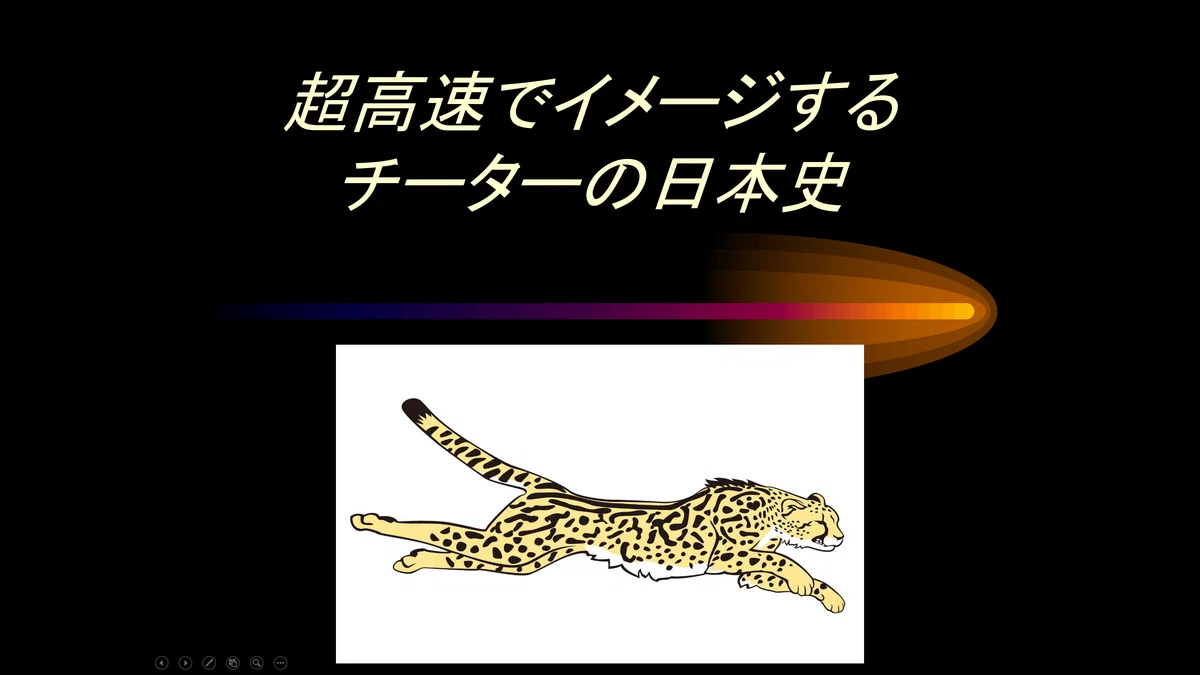
A revolutionary reference book specialized in image memory techniques
A teaching material that allows you to understand Japanese history while utilizing images in a short time and with minimal effort.
That is "Cheetah's Japanese History: Visualizing at Super Speed."
This is truly the reference book I desperately wanted when I was a student.
It took about one year to develop.
There are four things I was strongly conscious of while creating this material.
1. Easy for beginners to understand, so it's hard to give up
I have thoroughly omitted the complex phrasing found in textbooks and other materials, and have explained things in simple terms.
Therefore, it is a material that is easy to understand and hard to give up on, even for beginners or those who are not good at Japanese history.

2. Easy to remember because it specializes in image memory techniques
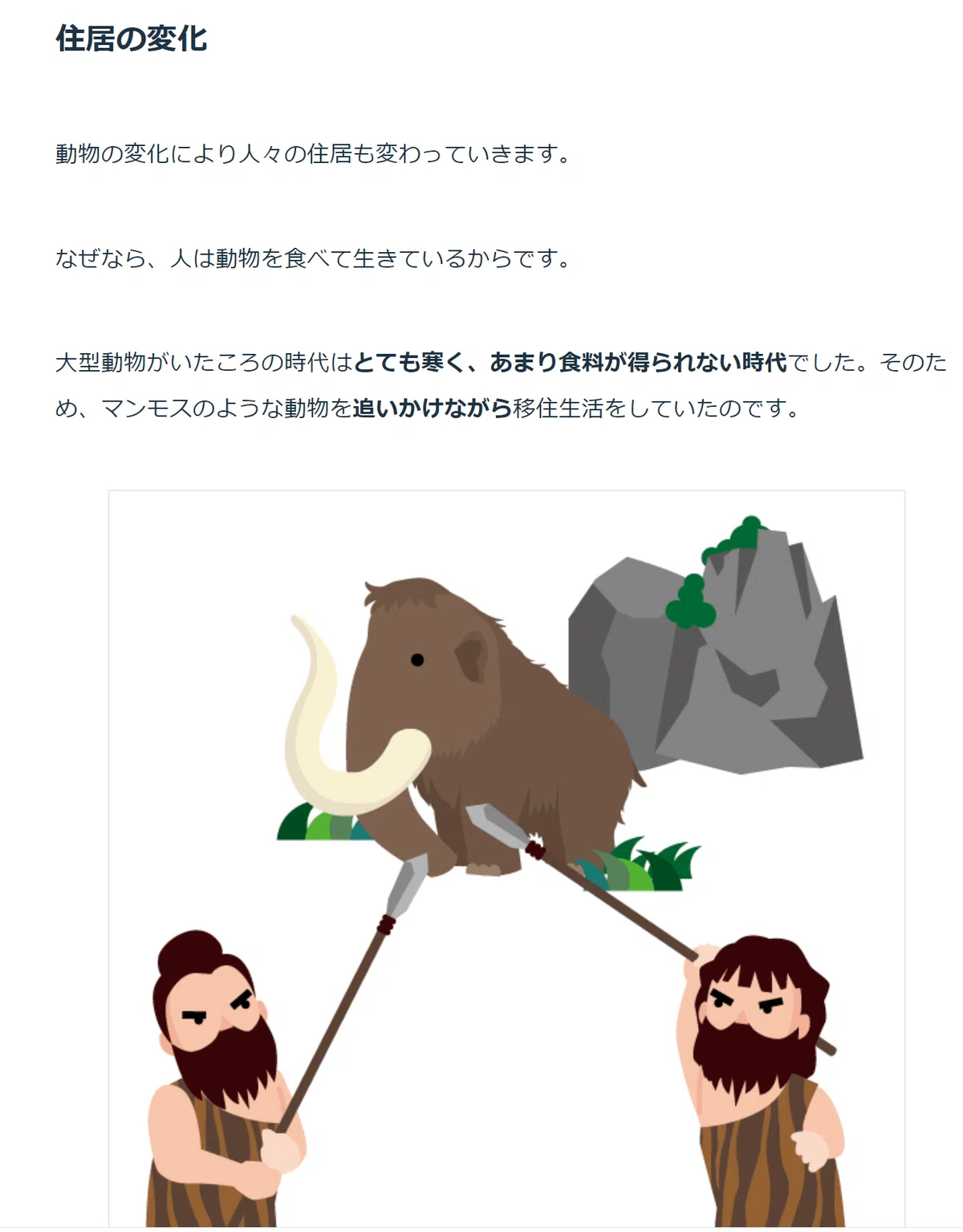
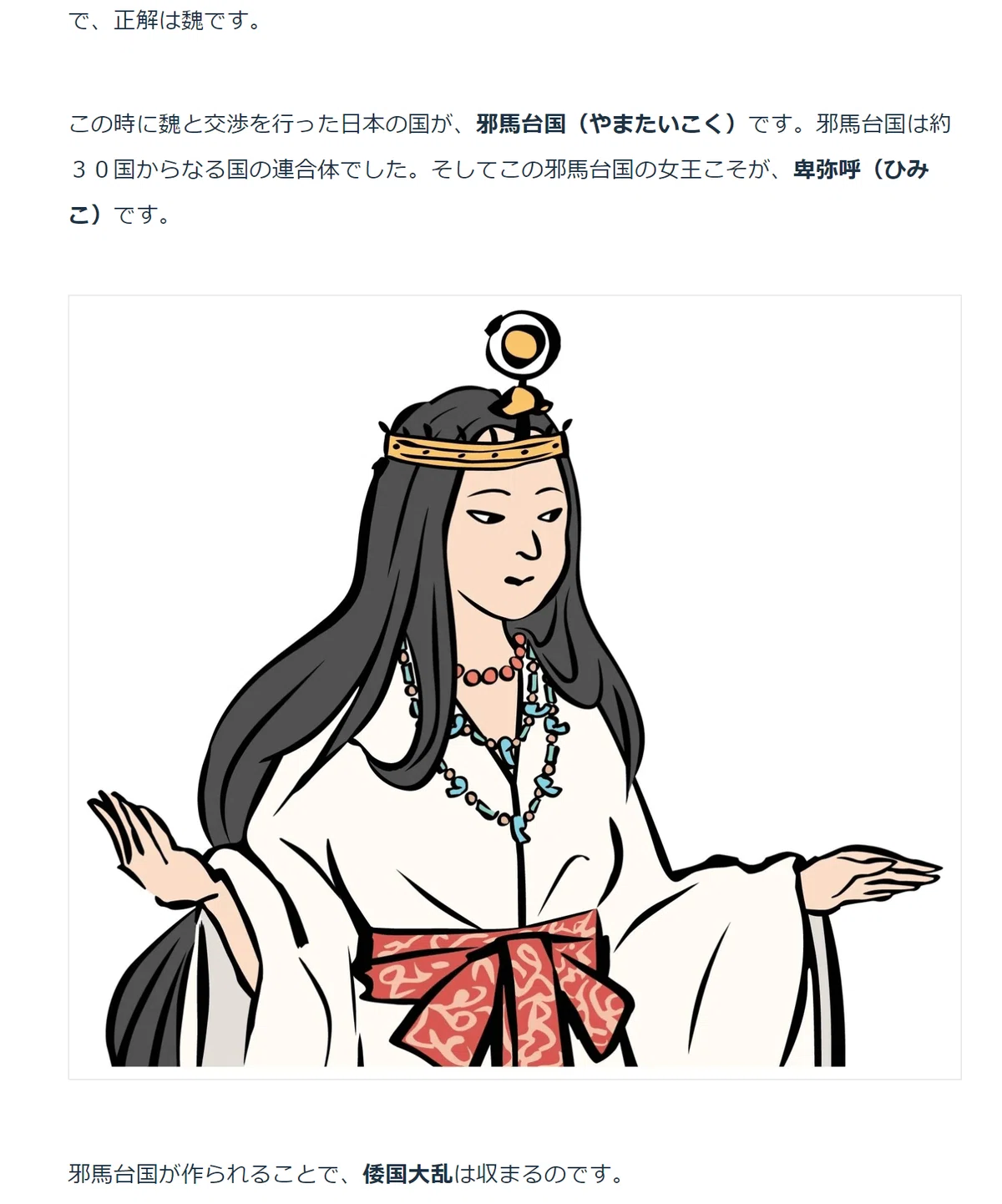
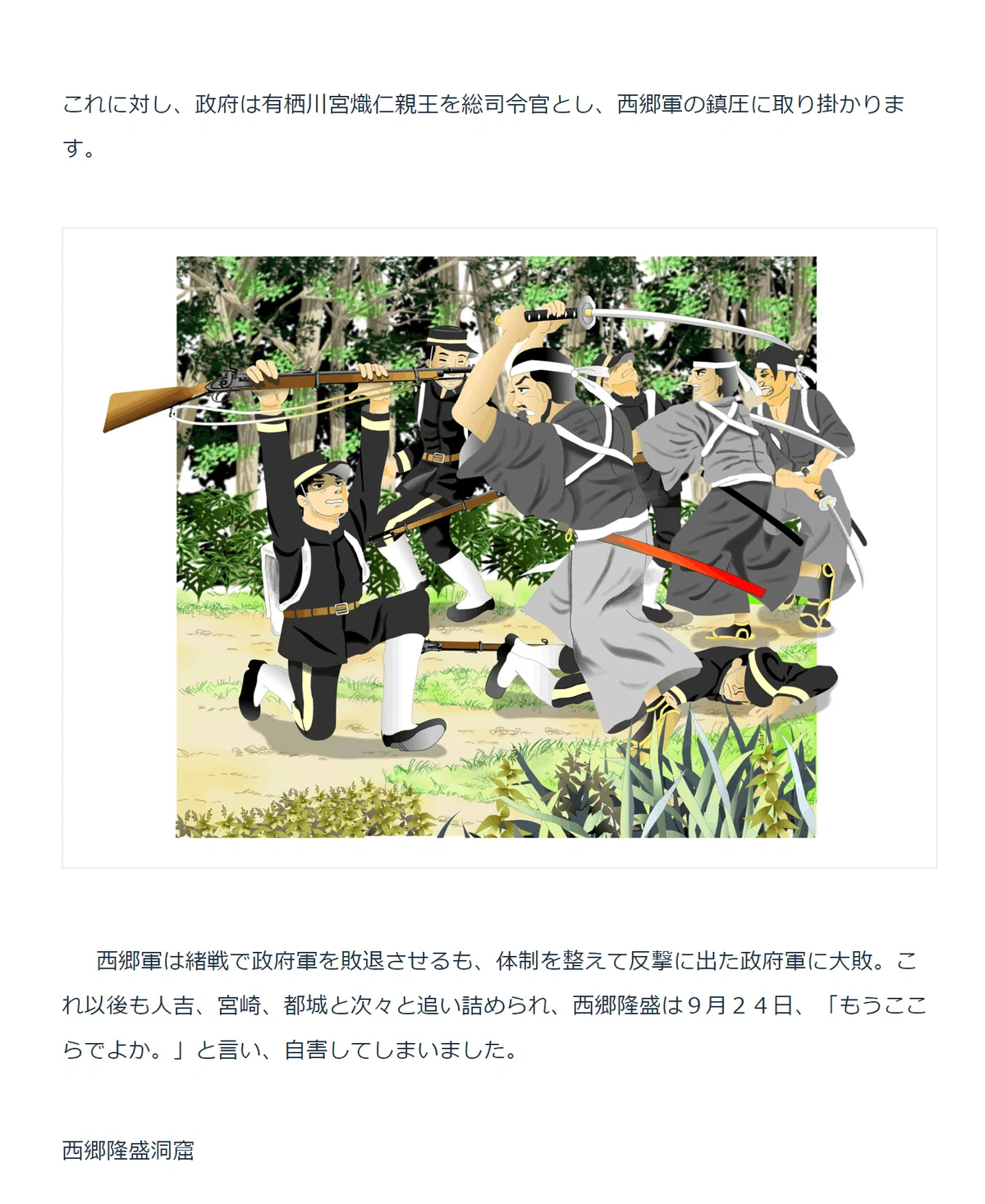
Because many images are included between explanations, you can use image memory techniques to learn.
I have designed this so you can understand through images without having to use the time-consuming and laborious study methods I used when I was a student.
Actual images
3. Master each era in as little as 40 minutes
It is said that the number of characters a person can read in one minute is about 600.
This material contains less than 45,000 characters from the Paleolithic period to the Edo period, and about 73,000 characters from the Meiji period to the Heisei period.
In other words, from the Paleolithic period to the Edo period, each series takes as little as less than 2 hours to complete.
Even for the complex Meiji to Reiwa periods, which have a lot to memorize, you can finish in as little as under 4 hours.
Paleolithic to Nara period: 2 hours
Heian to Muromachi period: 2 hours
Azuchi-Momoyama to Edo period: 2 hours
Meiji to Reiwa period: 4 hours
Also, there are a total of 15 eras from the Paleolithic period to the Reiwa period.
10 hours (600 minutes) ÷ 15 = 40
In short, you can learn each era in just 40 minutes.
This is top-class speed among the many Japanese history reference books available.

As you can see from the graph, you can finish about 4 to 6 times faster than commercially available reference books.
* There are 4 books in the Cheetah's Japanese History series in total.
Paleolithic to Nara period: 2 hours
Heian to Muromachi period: 2 hours
Azuchi-Momoyama to Edo period: 2 hours
Meiji to Reiwa period: 4 hours
are the estimated times.
(4) Because it's an e-book, it's convenient to carry around!
Traditional reference books were a real hassle to carry around. After all, they were heavy.

On the other hand, since this reference book is an e-book, you can just download it to your smartphone
and learn whenever you like.

User Testimonials


*Mosaic applied for personal information protection.
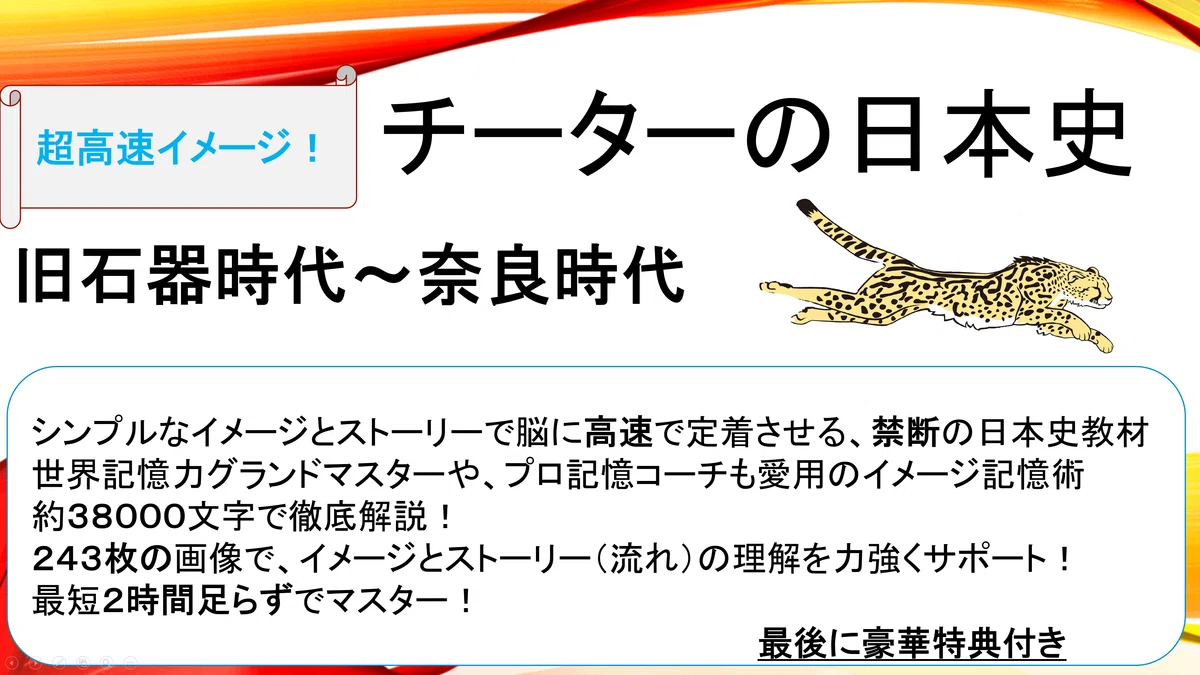
There are a total of 4 works in the "Cheetah's Japanese History" series.
Paleolithic Period to Nara Period Edition
☆Includes an intensive lecture on period classification
Heian Period to Muromachi Period Edition


☆Includes an intensive lecture on period classification
Azuchi-Momoyama Period to Edo Period Edition


Meiji Era to Reiwa Era Edition

The total number of images used is a staggering 1,039!
Author Profile
Road

Japanese History Instructor. Discovered image memory techniques while in high school and raised my deviation score from
2 months to 48 to 67. Benesse/Sundai Common Test Mock Exam School Overall
1st Place Deviation Score 72.2 Benesse/Sundai Descriptive Mock Exam School Overall
1st Place Deviation Score 69.4Highest Deviation Score 77.7
GPA 4.7
Price
I have invested over 100,000 yen in teaching materials and have watched over
1,000 lecture videos (totaling over 500 hours).
Also, it took me about 1 year to compile the knowledge I gained in this way into teaching materials.
"Cheetah's Japanese History: Visualizing at Super Speed" is the culmination of that work.
The price of a reference book that allows you to learn
high-quality Japanese history in just 2 to 4 hours per series is,
1,980 yen per series.
*One volume is free.
Two Deluxe Special Benefits

Bonus 1: Intensive Lectures on Periodization x 2
Do you know what event marks the beginning of the Nara period, or what event triggered the transition to the Heian period?
One thing that is surprisingly left vague in textbooks and other reference materials is periodization.
Honestly, it is dangerous to take an exam while your understanding of periodization remains vague.

This is because there are quite a few events that look like they belong to the Asuka period but are actually from the Nara period.
When I was a student, I failed many times because I didn't understand periodization.

Therefore, in this material, I have included lectures to help you
clearly understand periodization, such as 'this is where the Nara period starts and ends,'
as 'Intensive Lectures on Periodization.'

By taking these lectures, questions like 'Wait, which period did this event happen in?' will be resolved as if by magic.

* This lecture is included in two series: the 'Paleolithic to Nara Period Edition' and the 'Heian to Muromachi Period Edition.'
Bonus 2: Cheetah's Japanese History PDF Version for Easy Learning Anytime
I will give you the PDF version of 'Cheetah's Japanese History: Visualizing at Super Speed.'

If you save this PDF file to your smartphone or an app like Drive, you can study whenever you like.
* This Bonus 2 is included with all series.
Target Audience
I do not recommend this for the following people.
・People who do not need to study Japanese history
・People who have already perfected Japanese history up to the level of top-tier universities
・People who want to study only by memorizing text
On the other hand, this is recommended for the following people:
・People who are not good at Japanese history
・People who want to reduce study time as much as possible
・People who want to break away from study methods that only involve looking at or writing printed text
・People who are working hard but not seeing results
・People who want to relearn Japanese history in a short amount of time
Limited Time Special Offer

One reference book (worth 1,980 yen) for free.
Surprisingly, this time, we have decided to provide the first volume of Cheetah's Japanese History,Paleolithic Period to Nara Period Edition, for free!
This will likely be the last time we offer this service.
Do not miss this opportunity.
Receive Cheetah's Japanese History: Visualizing at Super Speed (Paleolithic Period to Nara Period) for free ↓
[50% OFF] A phenomenal 4,000 yen discount!
Furthermore, from June 11th to June 27th only, for those who purchase as a set,
instead of 1,980 yen x 4 = 7,920 yen,
you can purchase it for 4,000 yen off, which is 3,980 yen.
In other words, if you buy 4, 2 are free.
Simply put, it's half price.
*However, this is limited to customers purchasing the 4-book set.
Of course, the first volume (Paleolithic Period to Nara Period) is free regardless of whether you purchase the set.

Get 'Cheetah's Japanese History: Visualizing at Super Speed (Paleolithic Period to Nara Period)' for free here ↓
Purchase the great value set here. ↓
Speed is life in entrance exam preparation.
It is often said, but students have no time. Speed is truly life.
That is precisely why you should finish Japanese history as quickly as possible.
Time is limited, after all.
To achieve that, utilizing highly effective image memory techniques is the shortest path.

Memorizing only text and forcing knowledge and sequences into your head.
Why not graduate from that study method already?
Let's get a big lead on your rivals with 'Cheetah's Japanese History'.
Get Cheetah's Japanese History: Visualizing at Super Speed (Paleolithic Period to Nara Period) for free here ↓
Click here to purchase the value set ↓