


 扫一扫
扫一扫


 本文详细阐述了Java中的安全提供者机制,包括其在JavaCryptographyArchitecture中的角色、核心组件如Provider、Service和Algorithm类,以及如何通过系统属性、配置文件和代码动态管理安全提供者。开发者可根据需求选择和定制安全实现,确保应用程序的数据安全和身份验证。
Java安全
安全提供者
在Java中,安全提供者(Security
Provider)是一种实现了特定安全服务的软件模块。它提供了一系列的加密、解密、签名、验证和随机数生成等安全功能。安全提供者基础设施在Java中的作用是为开发人员提供一种扩展和替换标准安全功能的方式,以满足特定的安全需求。Java的安全提供者基础设施是通过Java Cryptography
Architecture(JCA)实现的。JCA定义了一组API和框架,用于在Java平台上实现各种安全服务。安全提供者是JCA的核心组件之一,它通过实现JCA规范中定义的接口,向应用程序提供安全功能。安全提供者可以由Java平台提供的默认提供者,也可以是第三方开发的提供者。默认提供者包含在Java开发工具包(JDK)中,并提供了一些常见的加密算法和安全功能。第三方提供者则可以通过扩展JCA接口,实现自定义的加密算法和其他安全功能。
使用安全提供者,开发人员可以在应用程序中轻松地切换和配置不同的安全实现。例如,可以根据具体的安全需求选择不同的提供者,或者通过配置文件动态加载和替换提供者。这种灵活性使得Java应用程序能够适应不同的安全环境和要求。
总之,Java中的安全提供者基础设施允许开发人员使用标准或自定义的安全功能,以保护和加密数据,验证身份,以及执行其他与安全相关的操作。它为Java应用程序提供了一种可扩展和灵活的安全解决方案。
安全提供者体系结构
提供了两个概念的抽象:引擎和算法
引擎
- 安全提供者提供了操作,这些操作就是引擎的抽象
算法
- 算法如何具体执行,引擎的不同算法的实现
消息摘要就是一个引擎,是程序员所能执行的一个操作
消息摘要的操作是与具体计算算法无关的
安全提供者体系结构中的组件
Java安全提供者Provider体系结构中涉及到的主要组件包括以下几个方面:
- Provider类
Provider类是Java安全API提供商的实现类。它们实现了Java提供的标准接口,并提供了一组安全算法实现。每个Provider类都有一个唯一的名称,用于标识它们在Java运行时环境中的身份。开发人员可以通过API或者配置文件指定使用哪一个Provider类来实现相应的安全功能。
- Service类
Service类是Provider类的组成部分,它是实现特定算法的类。Service类提供了各种算法的实现,包括加密、签名、哈希等。Service类还提供了一组支持该算法的参数和属性。
- Algorithm类
Algorithm类是Java安全API提供的加密算法、哈希算法、签名算法等的抽象基类。它定义了与特定算法相关的所有方法和属性,以及与该算法相关的所有参数和属性。
- Key类
Key类是Java安全API提供的密钥的抽象基类。它定义了生成和管理密钥的所有方法和属性。开发人员可以使用Key类来创建、存储、和翻译密钥。
- Certificate类
Certificate类是Java安全API提供的证书的抽象基类。它定义了数字证书的结构和内容。开发人员可以使用Certificate类来创建、处理、验证数字证书。
In the architecture of the security provider (provider) in Java security,
there are several key components:
- Provider: A provider is an implementation of the java.security.Provider
class. It is responsible for providing specific security services, such as
cryptographic algorithms, key management, secure random number generation,
and more. Each provider has a unique name and can be registered and used by
the Java security framework.- Service: A service represents a specific security functionality
provided by a provider. It is implemented as a subclass of the
java.security.Provider.Service class. Examples of services include
encryption algorithms, digital signature algorithms, key generators, and
secure random number generators.- Algorithm: An algorithm is a specific implementation of a cryptographic
operation or security function. It is identified by a unique name and is
provided by a service within a provider. For example, the “AES” algorithm is
a specific implementation of the Advanced Encryption Standard.- Key: A key is a piece of information used in cryptographic operations,
such as encryption, decryption, signing, or verification. Keys can be
generated, stored, and managed by the security provider. Examples of keys
include symmetric encryption keys, asymmetric encryption keys (public and
private keys), and digital signature keys.- Secure Random: Secure random number generation is crucial for many
security operations. The secure random component of the provider generates
cryptographically strong random numbers that are suitable for use in key
generation, nonces, initialization vectors, and other security-related
purposes.
These components work together to provide a comprehensive security
infrastructure in Java. The provider offers various services with specific
algorithms, and keys can be generated and managed by the provider. The
secure random component ensures the generation of secure random numbers for
cryptographic operations. Developers can utilize these components to build
secure applications and implement various security functionalities.
安全提供者的选择


设置和选择查看
Java安全提供者的选择可以在启动JVM时通过指定系统属性
java.security.provider来设置,例如:java -Djava.security.provider=SunJCE ...可以使用以下命令查看当前使用的安全提供者:
java -Djava.security.debug=provider -version如果需要更改安全提供者,可以在代码中使用
Security.insertProviderAt(provider, position)方法将指定的安全提供者插入到安全提供者列表的指定位置。如果不指定位置,则默认为列表的末尾。另外,也可以在JRE安全配置文件中更改默认的安全提供者列表。在选择安全提供者时,需要根据具体的安全需求来选择,例如对称加密算法、非对称加密算法、消息摘要算法等。可以参考Java官方文档或第三方安全提供者的文档来选择合适的安全提供者。同时,还需要考虑安全提供者的性能、安全性和可靠性等因素。
Simply put
To set and view the security provider selection in Java, you can use the
following methods:
- Setting the Security Provider:
* Programmatically: You can set the security provider programmaticallyusing the
Securityclass. Use theSecurity.addProvider(Provider provider)method to add a provider to the list of available providers. The
provider added first will be the default provider.
* Configuration File: You can also set the security provider by
modifying thejava.securityconfiguration file located in the
JRE_HOME/lib/securitydirectory. In this file, providers are listed in the
order of preference. You can change the order or add/remove providers as per
your requirements.
2. Viewing the Security Provider:* Programmatically: You can use the `Security` class to view the list ofinstalled providers and their preference order. The
Security.getProviders()method returns an array of installed providers in
the JVM.
* Command Line: You can use thejava.security.propertiessystem
property to view the security provider configuration. Run the commandjava -Djava.security.properties=<path_to_file> -jar <your_jar_file>to specify a
custom properties file that contains the security provider configuration.
3. Changing the Security Provider:* Programmatically: To change the security provider at runtime, you canremove the existing provider using the
Security.removeProvider(String name)method and then add the desired provider using
Security.addProvider(Provider provider).
* Configuration File: To change the security provider permanently,
modify thejava.securityconfiguration file and reorder the providers as
needed.
4. Selecting the Security Provider:* By Default: If you don’t explicitly set the security provider, the JVMuses the default provider configured in the
java.securityfile. This
default provider is typically the first provider listed in the file.
* Programmatically: If you want to select a specific provider
programmatically, you can use theSecurity.setProperty(String key, String value)method to set thesecurity.providerproperty to the desired
provider’s name. This will override the default provider selection.
Remember that the exact steps and methods may vary depending on the Java
version and implementation you are using. It’s recommended to consult the
official Java documentation or relevant resources for your specific Java
version.
Provider 类
Java安全提供者(Security Provider)是Java
Security框架的核心组成部分之一,用于提供和管理加密算法、公钥证书、密钥库等安全相关的服务。Provider类是提供相关安全服务的实现类,每个Provider实现类都提供了多个算法的实现。在Java
Security框架中,一个Provider类的对象可以包含多个同类型的算法实现(每个算法实现都实现了JCA架构规定的相应API)。例如,一个Provider对象可以同时包含多个MessageDigest算法的实现,每个实现具有不同的算法名称。当需要使用算法时,可以通过算法名称获取相应的算法实现。使用Provider类创建Provider对象:
可以通过以下方式获取Provider对象:
- 根据名字获取:
Provider provider = Security.getProvider("BC");
- 根据类名获取:
Provider provider =Security.getProvider(BouncyCastleProvider.PROVIDER_NAME);
使用Provider类向Provider中添加算法实现:
- 在配置文件java.security中配置
可以通过修改jre/lib/security/java.security配置文件实现向Provider对象中添加算法实现。(以BC(BouncyCastle)Provider为例)
在java.security配置文件中添加如下配置:
security.provider.1=org.bouncycastle.jce.provider.BouncyCastleProvider
- 在代码中添加
Security.addProvider(new BouncyCastleProvider());在代码中添加时,需要确保添加的Provider对象还没有添加到Provider列表中。还可以根据需求来指定提供者的优先级。
Provider类方法说明:
Provider类提供了许多方法,常用的方法如下:
- getName():
获取Provider对象的名字。
String name = provider.getName();
- getVersion():
获取Provider对象的版本号。
double version = provider.getVersion();
- getService():
通过类型和算法名获取提供者的服务。
Service service = provider.getService("Cipher","AES/CBC/PKCS5Padding");
- getServices():
获取Provider对象所有提供的服务。
Set<Service> services = provider.getServices();
- put():
向Provider对象中添加服务,该方法需要传入一个Service对象。
provider.put(newService(provider,“Myalgo”,“MyAlgorithm”,MyAlgorithm.class.getName(),null,null));
Provider类还提供了其他一些方法,如hashtable、枚举等等。具体可以查看Java API文档。
Security 类
- 管理java程序中所要用到的提供者类。
- 并且在安全提供者体系结构建立最后一个环节
看看安全提供者的保驾护航
public static void main(String[] args) {
        Provider[] providers = Security.getProviders();
        for(Provider provider : providers) {
            System.out.println("Provider: " + provider.getName() + " version " + provider.getVersion());
            for(Object service : provider.keySet()) {
                System.out.println("  Service: " + service);
            }
        }
    }
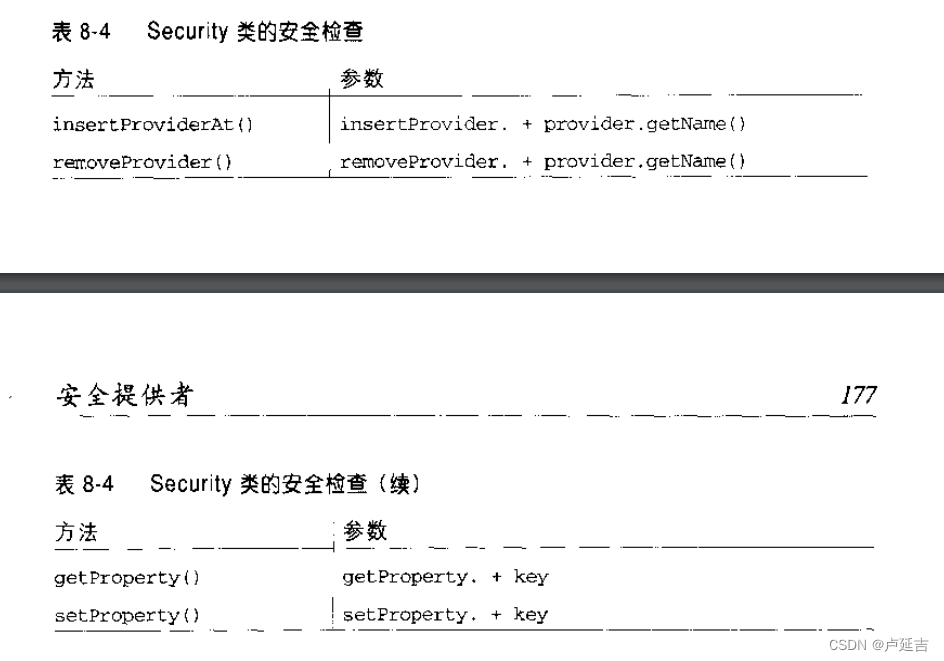
Security类和安全管理器
Security公共类调用要调用安全管理器方法,保证在不可信的类调用影响到虚拟机的时候能够进行干预处理。
引擎类体系结构


学习计划安排

我一共划分了六个阶段,但并不是说你得学完全部才能上手工作,对于一些初级岗位,学到第三四个阶段就足矣~
这里我整合并且整理成了一份【282G】的网络安全从零基础入门到进阶资料包,需要的小伙伴可以扫描下方CSDN官方合作二维码免费领取哦,无偿分享!!!
如果你对网络安全入门感兴趣,那么你需要的话可以
点击这里👉网络安全重磅福利:入门&进阶全套282G学习资源包免费分享!
①网络安全学习路线
②上百份渗透测试电子书
③安全攻防357页笔记
④50份安全攻防面试指南
⑤安全红队渗透工具包
⑥HW护网行动经验总结
⑦100个漏洞实战案例
⑧安全大厂内部视频资源
⑨历年CTF夺旗赛题解析
 ## 题外话
初入计算机行业的人或者大学计算机相关专业毕业生,很多因缺少实战经验,就业处处碰壁。下面我们来看两组数据:
2023届全国高校毕业生预计达到1158万人,就业形势严峻;
国家网络安全宣传周公布的数据显示,到2027年我国网络安全人员缺口将达327万。
一方面是每年应届毕业生就业形势严峻,一方面是网络安全人才百万缺口。
6月9日,麦可思研究2023年版就业蓝皮书(包括《2023年中国本科生就业报告》《2023年中国高职生就业报告》)正式发布。
2022届大学毕业生月收入较高的前10个专业
本科计算机类、高职自动化类专业月收入较高。2022届本科计算机类、高职自动化类专业月收入分别为6863元、5339元。其中,本科计算机类专业起薪与2021届基本持平,高职自动化类月收入增长明显,2022届反超铁道运输类专业(5295元)排在第一位。
具体看专业,2022届本科月收入较高的专业是信息安全(7579元)。对比2018届,电子科学与技术、自动化等与人工智能相关的本科专业表现不俗,较五年前起薪涨幅均达到了19%。数据科学与大数据技术虽是近年新增专业但表现亮眼,已跻身2022届本科毕业生毕业半年后月收入较高专业前三。五年前唯一进入本科高薪榜前10的人文社科类专业——法语已退出前10之列。
“没有网络安全就没有国家安全”。当前,网络安全已被提升到国家战略的高度,成为影响国家安全、社会稳定至关重要的因素之一。
网络安全行业特点
1、就业薪资非常高,涨薪快 2022年猎聘网发布网络安全行业就业薪资行业最高人均33.77万!

2、人才缺口大,就业机会多
2019年9月18日《中华人民共和国中央人民政府》官方网站发表:我国网络空间安全人才 需求140万人,而全国各大学校每年培养的人员不到1.5W人。猎聘网《2021年上半年网络安全报告》预测2027年网安人才需求300W,现在从事网络安全行业的从业人员只有10W人。

行业发展空间大,岗位非常多
网络安全行业产业以来,随即新增加了几十个网络安全行业岗位︰网络安全专家、网络安全分析师、安全咨询师、网络安全工程师、安全架构师、安全运维工程师、渗透工程师、信息安全管理员、数据安全工程师、网络安全运营工程师、网络安全应急响应工程师、数据鉴定师、网络安全产品经理、网络安全服务工程师、网络安全培训师、网络安全审计员、威胁情报分析工程师、灾难恢复专业人员、实战攻防专业人员…
职业增值潜力大
网络安全专业具有很强的技术特性,尤其是掌握工作中的核心网络架构、安全技术,在职业发展上具有不可替代的竞争优势。
随着个人能力的不断提升,所从事工作的职业价值也会随着自身经验的丰富以及项目运作的成熟,升值空间一路看涨,这也是为什么受大家欢迎的主要原因。
从某种程度来讲,在网络安全领域,跟医生职业一样,越老越吃香,因为技术愈加成熟,自然工作会受到重视,升职加薪则是水到渠成之事。
黑客&网络安全如何学习
今天只要你给我的文章点赞,我私藏的网安学习资料一样免费共享给你们,来看看有哪些东西。
1.学习路线图
行业发展空间大,岗位非常多
网络安全行业产业以来,随即新增加了几十个网络安全行业岗位︰网络安全专家、网络安全分析师、安全咨询师、网络安全工程师、安全架构师、安全运维工程师、渗透工程师、信息安全管理员、数据安全工程师、网络安全运营工程师、网络安全应急响应工程师、数据鉴定师、网络安全产品经理、网络安全服务工程师、网络安全培训师、网络安全审计员、威胁情报分析工程师、灾难恢复专业人员、实战攻防专业人员…
职业增值潜力大
网络安全专业具有很强的技术特性,尤其是掌握工作中的核心网络架构、安全技术,在职业发展上具有不可替代的竞争优势。
随着个人能力的不断提升,所从事工作的职业价值也会随着自身经验的丰富以及项目运作的成熟,升值空间一路看涨,这也是为什么受大家欢迎的主要原因。
从某种程度来讲,在网络安全领域,跟医生职业一样,越老越吃香,因为技术愈加成熟,自然工作会受到重视,升职加薪则是水到渠成之事。
黑客&网络安全如何学习
今天只要你给我的文章点赞,我私藏的网安学习资料一样免费共享给你们,来看看有哪些东西。
1.学习路线图

攻击和防守要学的东西也不少,具体要学的东西我都写在了上面的路线图,如果你能学完它们,你去就业和接私活完全没有问题。
2.视频教程
网上虽然也有很多的学习资源,但基本上都残缺不全的,这是我自己录的网安视频教程,上面路线图的每一个知识点,我都有配套的视频讲解。
内容涵盖了网络安全法学习、网络安全运营等保测评、渗透测试基础、漏洞详解、计算机基础知识等,都是网络安全入门必知必会的学习内容。
3.技术文档和电子书
技术文档也是我自己整理的,包括我参加大型网安行动、CTF和挖SRC漏洞的经验和技术要点,电子书也有200多本,由于内容的敏感性,我就不一一展示了。
4.工具包、面试题和源码
“工欲善其事必先利其器”我为大家总结出了最受欢迎的几十款款黑客工具。涉及范围主要集中在 信息收集、Android黑客工具、自动化工具、网络钓鱼等,感兴趣的同学不容错过。
还有我视频里讲的案例源码和对应的工具包,需要的话也可以拿走。
这些题目都是大家在面试深信服、奇安信、腾讯或者其它大厂面试时经常遇到的,如果大家有好的题目或者好的见解欢迎分享。
参考解析:深信服官网、奇安信官网、Freebuf、csdn等
内容特点:条理清晰,含图像化表示更加易懂。
内容概要:包括 内网、操作系统、协议、渗透测试、安服、漏洞、注入、XSS、CSRF、SSRF、文件上传、文件下载、文件包含、XXE、逻辑漏洞、工具、SQLmap、NMAP、BP、MSF…

因篇幅有限,仅展示部分资料,需要点击下方链接即可前往获取
如果你对网络安全入门感兴趣,那么你需要的话可以点击这里👉网络安全重磅福利:入门&进阶全套282G学习资源包免费分享!


 2848
2848

 被折叠的 条评论
为什么被折叠?
被折叠的 条评论
为什么被折叠?
 到【灌水乐园】发言


